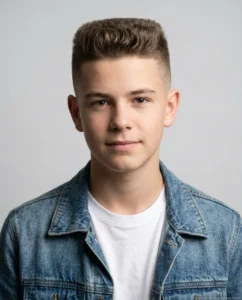
The low fade doesn’t get enough credit. Most of the conversation around fades goes to the skin fade and the high fade — the dramatic ones, the ones that make an obvious statement. The low fade is quieter. It starts close to the natural hairline, graduates subtly, and leaves the sides looking clean without going so short that it demands constant refreshing. For straight hair specifically, that subtlety is an advantage.
Straight hair shows off a low fade better than almost any other texture. The clean graduation reads clearly because there’s no curl or wave to soften the line work — every millimeter of the fade is visible and precise. These 9 styles were chosen specifically because they work well with straight hair and a low fade. Some are zero-effort. Some take a few minutes. All of them look sharp.
1. Low Fade with Textured Crop

The textured crop with a low fade is probably the most versatile combination on this list. The low fade keeps the sides defined without going extreme, and the textured crop on top — around 1.5 to 2.5 inches — uses the natural structure of straight hair to create a surface that looks like it has more going on than it actually does. Straight hair holds texture well at this length. Push it slightly forward, scrunch it a bit, and the fringe creates a soft horizontal line that frames the face cleanly.
The low fade specifically suits the textured crop because it doesn’t compete with the top. A high fade would pull attention to the sides. A low fade just frames the whole thing quietly. A small amount of matte clay worked through dry hair gives the texture definition without any shine or weight. Morning routine: under 2 minutes. That’s the honest reality of this style done right.
2. Low Fade with Side Part

Straight hair and a side part is a combination that has worked for about 80 years and will keep working because the logic behind it is sound. Straight hair holds a side part without any help — no spray, no pins, no fighting the hair into position every morning. The strands fall naturally to one side and stay there. The low fade underneath keeps the sides from looking heavy, which is the main thing that can go wrong with a side part on straight hair when it’s left without any graduation.
This is the most office-appropriate style on this list. It reads as polished and intentional without requiring much effort to maintain. The low fade grows out more gracefully than a skin fade — you can go 3 to 4 weeks between cuts without it looking obviously grown-out. A light-hold pomade combed through damp hair and swept to one side is all this needs. Apply it, comb it, walk out the door.
3. Low Fade with Slick Back

The slick back on straight hair is one of those combinations where the texture does the work for you. Straight hair falls naturally backward without any encouragement — there’s no curl to fight, no wave pulling it in a different direction, no volume you have to beat down with product. You comb it back, it goes back, it stays. The low fade keeps the sides from adding unnecessary width to what is already a full-on-top silhouette.
The low fade version of the slick back is more wearable day-to-day than the high fade version. The fuller sides balance the slicked-back top more naturally, and the whole thing looks less aggressive — more suited to a range of contexts rather than just one specific aesthetic. You need at least 3 inches on top for the slick back to read properly. A medium-hold pomade with some shine worked through damp hair and combed straight back is the standard approach. Air dry for the most natural finish.
4. Low Fade with French Crop

The French crop is the most underrated style on this list. Short blunt top, fringe sitting just above the eyebrows, low fade keeping the sides clean. No styling required. At all. You wash it, towel dry, walk out, it looks exactly right. For men who want a haircut that works without any morning effort — not as a compromise but as a genuine goal — the French crop with a low fade is the answer.
Straight hair is the ideal texture for the French crop because the blunt fringe sits flat and even without any product. The strands have uniform weight and fall forward in a clean horizontal line. No curl to fight, no wave bouncing the fringe back up. The main maintenance requirement is the fringe edge — it needs to stay clean, so barber visits every 4 to 5 weeks are non-negotiable. Let it grow and the whole shape falls apart. Stay on top of it and the style maintains itself almost automatically.
5. Low Fade with Crew Cut

The crew cut with a low fade has been working in barbershops for six decades. There’s a reason it hasn’t been replaced. Short on top — around 1 to 1.5 inches — clean on the sides, low graduation that doesn’t draw attention to itself. Straight hair at crew cut length stands slightly upright, which gives the illusion of more volume than there actually is. The low fade adds just enough definition to make the whole thing look like a deliberate choice rather than just a short haircut.
This grows out better than almost anything else on this list. The low taper means the sides look acceptable for 4 weeks without anyone noticing it’s grown out. If you’re someone who can only get to the barber every month, the low fade crew cut is your best option. No product needed. No styling needed. It’s the definition of set-it-and-forget-it haircut strategy.
6. Low Fade with Comb Over

The low fade comb over is probably the most versatile style on this list in terms of context. It works at the office. It works at a wedding. It works on a first date. It works on a Sunday. The low fade keeps the sides defined without going so short that the style reads as aggressively styled, and the straight hair comb over sweeps naturally to one side with minimal product and stays there all day. The combination is effortlessly put-together in a way that takes about 90 seconds to achieve.
What makes straight hair particularly good for a comb over is direction — the strands flow naturally to one side without fighting. Wavy hair sometimes resists. Curly hair springs back. Straight hair just goes where you comb it. A light-hold cream or pomade fingertip-applied and combed to one side is genuinely all this needs. Keep it light — too much product and the comb over starts to look stiff rather than natural.
7. Low Fade with Quiff

The quiff on straight hair is more achievable than most men expect. There’s a common belief that you need volume or texture to build a quiff — that straight hair won’t hold it. That’s not accurate. Straight hair with the right product and a blow dryer builds a clean, structured quiff that holds for 6 to 8 hours without touching it again. The low fade on the sides keeps the contrast relatively subtle, which suits a quiff well — the top is doing all the work visually and the sides don’t need to compete.
Getting the shape right requires a blow dryer and a round brush. Air drying a quiff on straight hair leaves it flat — the roots need heat and lift to build upward. Blow dry on medium heat aimed at the roots, brush upward and slightly forward, until the shape holds. A medium-hold matte clay worked through before blow-drying gives grip and definition without the stiffness that gel produces. Stop blow-drying when the hair is about 80% dry and let it finish naturally.
8. Low Fade with Buzz Cut

The buzz cut with a low fade is the most honest style on this list. It doesn’t try to create the illusion of anything. It’s not trying to look like more hair or more volume or more length. It’s just a clean, short haircut with a subtle graduation on the sides that gives it shape without adding complexity. On straight hair, the buzz cut catches light evenly across the scalp — a subtle sheen that actually looks good rather than just flat.
The low fade adds shape to what would otherwise be a completely uniform buzz. It defines the hairline and gives the sides a clean structure that the buzz cut alone doesn’t have. Every few weeks maintenance is straightforward — the low fade is forgiving enough that it looks acceptable for 3 to 4 weeks between cuts. Zero styling, zero product, zero morning routine. If any part of your day involves not wanting to think about your hair, this is the correct choice.
9. Low Fade with Ivy League

The Ivy League — sometimes called the Princeton clip — is essentially a longer crew cut with a side part. It’s one of those styles that looks unremarkable in a description and genuinely sharp in person. The low fade keeps the sides clean, the top has enough length to sweep to one side, and the overall result is a put-together look that grows out well and requires minimal daily maintenance. Straight hair handles the Ivy League better than almost any other texture — the side part holds naturally and the top sweeps cleanly without needing constant product.
The Ivy League sits at a useful length — around 2 to 3 inches on top — that’s long enough to style in multiple directions if you want to change things up but short enough that it never looks unkempt. It’s the kind of style you can wear to a job interview and to the pub the same day without anyone thinking it looks out of place in either context. A small amount of light-hold pomade is all it needs. Goes on in 60 seconds, stays in place all day.
Final Thoughts
The low fade earns its place on straight hair precisely because it doesn’t try to do too much. It defines the sides quietly, lets the top style take the lead, and grows out well enough that you’re not locked into barber visits every 10 days. Every style on this list benefits from that restraint in a different way — some use it to create a polished professional look, others use it to let a more dramatic top style speak without competition.
Pick the one that matches how much time you want to spend in front of a mirror. Save it to Pinterest, bring the photo to your next appointment, and let the barber take it from there. Showing a picture is worth about five minutes of trying to describe what you want in words.