Haircut Styles Fade Cuts Trending About Follow on Pinterest
AGE Fade Haircuts HAIR LENGTH HAIR TYPE Haircuts for Men in 30s Haircuts for Wavy Hair Low Fade Medium Haircuts

The Best Low Fade Haircuts for Men with Wavy Hair That Barbers Actually Love Cutting

Wavy hair sits in an interesting middle ground. It has more natural movement than straight hair but less structure than curly hair, which means it responds well to a low fade without needing much product to hold a shape. The wave does the visual work on top — the fade just frames it. Get the balance right and you end up with a cut that looks considered on day one and still presentable on day four when you’ve done basically nothing to it.

Barbers genuinely enjoy cutting wavy hair because the texture is cooperative. It moves the way you ask it to, holds a style without fighting you, and photographs well at almost every length. The low fade is the right pairing here specifically — it’s subtle enough not to compete with the wave pattern on top, and clean enough to make the whole cut look intentional. These 10 options run from sharp and structured to loose and relaxed, covering the full range of what wavy hair can do with the right cut underneath it.

1. Low Fade with Wavy Textured Crop

man with wavy textured crop and low fade haircut

The wavy textured crop is one of those cuts that barbers actually look forward to because wavy hair makes it significantly easier to execute well. The top sits at around an inch to an inch and a half, short enough to keep the waves compact and defined rather than falling loose and formless. At that length the wave pattern shows clearly — each section sits slightly differently from the next, giving the top real texture without any product required. The low fade underneath keeps the sides tight and gives the short top enough visual contrast to read as a deliberate style rather than a neglected one.

Maintenance on this cut is about as low as it gets. Every 3 to 4 weeks to the barber, a light sea salt spray on damp hair if you want more wave definition, and you’re done. The honest limitation is face shape — this cut works well on oval, square, and diamond faces where the short top doesn’t draw attention to length. On longer face shapes it can make the face appear even longer, so it’s worth thinking about before committing. A good barber will flag this, but not all of them do.

Barber Tip: Ask for point-cutting on the top section rather than bulk-cutting — this lets each wave sit independently rather than clumping together. Keep the low fade starting right at the temple for the cleanest contrast with the textured top.

2. Low Fade with Wavy Slick Back

man with wavy slick back and low fade haircut

Wavy hair slicked back looks better than straight hair slicked back — full stop. The waves add movement and dimension to what on straight hair can look flat and one-dimensional. The wave pattern runs from front to back, catching light along each ridge and giving the whole top a natural depth that requires zero effort to achieve. Paired with a low fade and a blazer, this is one of the most versatile looks on this list — it works at a job interview, a wedding, and a casual dinner without changing anything about the cut.

The product choice matters more here than on most other cuts. A medium-hold pomade with some shine keeps the waves visible and the slick back in place without looking greasy. A light wax is the alternative if you want less shine and a slightly more relaxed finish. Either way, apply on damp hair after a shower, comb straight back, and let it set. Avoid heavy gels — they stiffen the waves and kill the movement that makes this cut work. Touch up the fade every 3 weeks or the sides start blending into the top and the slick back loses its definition.

Barber Tip: Ask for at least 3 to 4 inches on top so the waves have enough length to lay back cleanly. A gradual low taper fade rather than a skin fade works slightly better here — it keeps the transition softer and suits the more polished overall feel of this cut.

3. Low Fade with Wavy Side Part

man with wavy side part and low fade haircut

The wavy side part with a hard part shaved in is one of those cuts that looks like it belongs in a boardroom and on a rooftop bar simultaneously. The hard part — a razor line cut directly into the hair at the natural part — gives this cut an edge that a soft part simply doesn’t have. On wavy hair the longer side sweeps across with natural body and movement, which means you get a structured look without the stiffness that straight hair sometimes brings to this style. The low fade on the shorter side blends cleanly into the shaved part line.

This is a higher-maintenance cut than it looks. The hard part softens within 10 days and starts blending back into the surrounding hair, so if you want to keep the sharp look you’ll need touch-ups more often than the rest of the cut requires. The fade and top can go 3 to 4 weeks easily, but the part is closer to every 2 weeks for those who want it crisp. A medium-hold cream on the longer wavy side — worked through on damp hair and combed across — keeps the wave pattern intact without the crunch of a gel.

Barber Tip: Use a straight razor for the part line rather than a clipper blade — it gives a sharper, cleaner edge that holds longer. Ask for the fade to be a skin fade on the shorter side so the hard part reads as a deliberate design detail rather than just where the hair ends.

4. Low Fade with Wavy Ivy League

man with wavy ivy league cut and low fade haircut

The Ivy League is essentially a longer crew cut — short on the sides, slightly longer on top, with enough length at the front to push forward or to the side. On wavy hair it’s one of the cleanest options available because the waves add texture to what on straight hair can look almost too neat and flat. The wave pattern at the front creates a natural, slightly disheveled finish that stops the cut from looking stiff or overly corporate. It’s the kind of haircut that works in an office five days a week and doesn’t require any adjustment for the weekend.

The low fade here is a softer touch than a standard Ivy League usually gets — traditional versions often use a higher fade or a taper, but the low version is more relaxed and suits wavy hair’s natural looseness better. Top length should sit at about 2 to 2.5 inches to give the waves enough room to develop but not so much that the cut starts losing its classic proportions. Almost no product needed — a small amount of matte cream on damp hair, pushed forward slightly, is enough to define the wave at the front without looking styled.

Barber Tip: Ask for the top to be scissor-cut rather than clipped — scissors give a softer, more natural finish that works better with wavy texture. Tell your barber to leave just enough length at the front to push forward, around 2 to 2.5 inches.

5. Low Fade with Wavy Fringe

man with wavy fringe and low fade haircut

Wavy fringe falling forward is one of those combinations that looks genuinely effortless — and mostly is. The waves in the fringe section fall toward the forehead in a loose, natural cluster rather than a blunt straight line, which gives this cut a relaxed European quality that’s hard to achieve with straight hair. The low fade underneath keeps the sides controlled so the fuller fringe doesn’t make the overall shape look heavy or overgrown. At around 2 to 3 inches at the front, the fringe has enough length to wave rather than just flop.

The main thing to know upfront: humidity affects this cut more than almost any other on this list. On dry days the fringe falls forward in clean waves and everything looks intentional. On humid days the waves can swell outward rather than falling forward, and the fringe shape shifts noticeably. An anti-humidity spray helps but most men won’t bother. The honest answer is you accept the slight variation and move on — it still looks fine, just different. Daily styling is minimal: a small amount of wave cream scrunched into damp fringe, left to air dry, and done.

Barber Tip: Ask your barber to cut the fringe dry rather than wet — wavy hair can shrink significantly when wet and cutting it damp risks taking off more than intended. Each section of the fringe should be cut to fall at a slightly different length for the most natural result.

6. Low Fade with Wavy Messy Top

man with wavy messy top and low fade haircut

The messy wavy top with a low fade is the most forgiving cut on this list, and that’s not a criticism — it’s the point. The top is left at a medium length, around 3 to 4 inches, with the ends textured so the waves fall loosely without any particular direction. It looks like you ran your hands through it once after a shower and called it done. On wavy hair that actually is all it takes. The low fade underneath stops it from tipping over into looking unkempt by giving the sides a clean edge that signals the messiness on top is deliberate.

This is the cut most wavy-haired men end up with when they describe wanting something low-maintenance that still looks good. It delivers on that better than most guides admit. The only real styling requirement is not over-drying with a towel after washing — rough towel drying breaks up the wave pattern and creates frizz rather than the loose texture you want. Squeeze the hair gently with the towel instead, apply a light sea salt spray or a curl cream while it’s still damp, and let it air dry in whatever direction it falls naturally. Takes about 2 minutes.

Barber Tip: Ask for razor texturing or point-cutting on the ends of the top section — this breaks up the weight and lets each wave move independently. Without this step the top can sit as one heavy, flat section rather than the loose, layered result you’re after.

7. Low Fade with Long Wavy Top

man with long wavy top and low fade haircut

Long wavy hair on top paired with a low fade is where this hair type really shows what it can do. At 4 to 6 inches the waves develop full length and movement — they fall with real weight, shift when you move, and catch light across the ridges in a way shorter lengths simply can’t replicate. The low fade is doing critical work here: without it, the longer top blends into the sides and the cut loses its shape entirely, looking more overgrown than styled. With it, the contrast between the full wavy top and the tapered sides is what makes the whole thing read as intentional.

Growing this out takes time and patience. The awkward phase hits around weeks 6 to 10 when the top is long enough to be annoying but not long enough to style properly — it flops in different directions without committing to any of them. Most men give up here, which is a shame because another 4 to 6 weeks usually gets you past it. A leave-in conditioner on wash days and a light oil on dry days keeps the waves defined and prevents the frizz that comes with length. Daily maintenance runs about 4 to 6 minutes, which is the real cost of this cut.

Barber Tip: Ask for a soft, gradual low fade rather than a hard drop — a sharp fade line under long wavy hair looks disconnected and breaks the flow of the cut. The transition from faded sides to full wavy top should be smooth enough that the eye moves naturally between the two sections.

8. Low Fade with Wavy Pompadour

man with wavy pompadour and low fade haircut

The wavy pompadour is one of those cuts where the hair type actively improves the style. A classic pompadour on straight hair can look almost theatrical — very precise, very deliberate, very high-shine. On wavy hair the same shape reads as naturally voluminous rather than forced, because the waves add body to the lift without needing product to manufacture it. The hair goes upward and slightly back, the waves run through the length of it, and the low fade underneath keeps the sides tight enough to make the volume on top look proportional rather than overwhelming.

Styling takes about 5 minutes and requires a medium-hold pomade — enough to keep the lift in place without making the waves look crunchy or wet. Apply on damp hair, blow dry upward and slightly back with a round brush to set the shape, then finish with a light pass of pomade through the top for hold. Don’t overdo the product — wavy hair holds shape more naturally than straight hair and needs less assistance than you think. The fade needs touching up every 2 to 3 weeks or the sides grow in and reduce the contrast that makes the pompadour volume pop.

Barber Tip: Ask for at least 3.5 to 4 inches on top for the pompadour to have enough length to lift and fall back convincingly. A skin fade starting just above the ear gives the cleanest contrast with the fuller top — anything higher starts competing with the volume rather than framing it.

9. Low Fade with Wavy Quiff

man with wavy quiff and low fade haircut

The wavy quiff sits between the pompadour and the messy top in terms of structure — more intentional than the latter, less formal than the former. The hair at the front is pushed forward and slightly upward, the waves add natural lift without requiring blow drying, and the whole thing falls into place with minimal intervention. On wavy hair this cut works better than most people expect because the wave pattern does most of the heavy lifting. The front section has enough body to hold a slight rise on its own, which means you’re maintaining a shape rather than building one from scratch every morning.

The low fade here suits the relaxed energy of the quiff well — a higher fade would make it feel more structured and less casual, which isn’t really the point. Top length should be around 3 to 4 inches for the quiff to have room to work with. A lightweight curl cream or a sea salt spray on damp hair, pushed forward with the fingers and left to air dry, is all the styling most wavy-haired men will need. On days you want more definition, a small amount of matte clay through the front section adds hold without killing the natural movement.

Barber Tip: Ask your barber to leave the front section slightly longer than the rest of the top — around a half inch more — so it has enough weight to fall forward naturally into the quiff shape without needing product to force it.

10. Low Fade with Wavy Curtain Hair

man with wavy curtain hair and low fade haircut

Curtain hair on wavy hair is genuinely one of the better combinations going right now. The hair parts in the middle and falls to either side — on wavy hair the sections don’t fall flat the way they do on straight hair, they curve outward and frame the face with real movement. The length at the sides of the top can reach the cheekbones or just past the ear depending on how long you’ve grown it, and the waves get more pronounced and better defined as the length increases. The low fade underneath is the modern detail that stops this from looking like a throwback — without it, long curtain hair reads differently, more period-specific, less current.

Growing curtain hair out from a shorter cut takes around 4 to 6 months, with the genuinely difficult stretch happening between weeks 8 and 14 when the hair is in an in-between length that doesn’t part cleanly or fall neatly. A small amount of lightweight oil — argan or jojoba — applied to slightly damp hair and then left alone does most of what you need on a daily basis. The low fade needs touching up every 3 weeks or the sides start growing in and closing the gap between the faded section and the longer top, which softens the contrast that makes this cut so clean.

Barber Tip: Ask for a soft low fade that starts no higher than the temple — this gives the longer curtain top plenty of room to fall naturally without the fade cutting into it too early. Tell your barber to blend gradually rather than dropping sharply at the fade line.
AGE Fade Haircuts Haircuts for Wavy Hair Teen Boy Haircuts

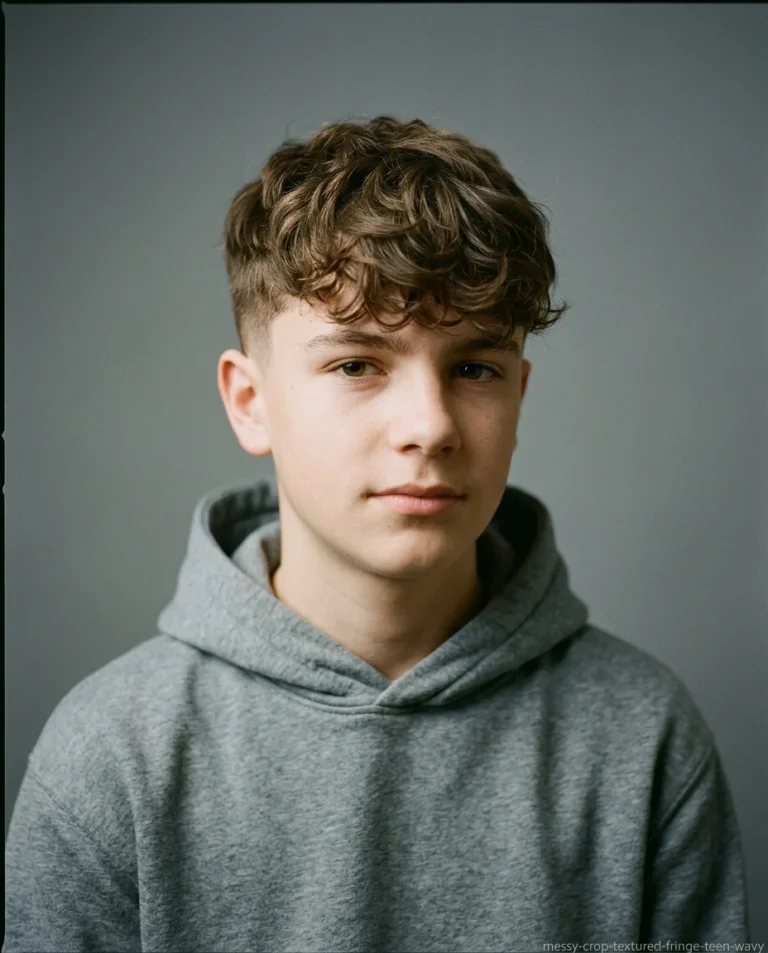
13 Cool Wavy Hair Fade Haircuts Every Teen Boy Needs to Try

Wavy hair at that teenage awkward-growth stage gets a bad reputation. Too much volume, not enough length to control it, grows out unevenly — it can feel like the hair is actively working against you. A fade fixes most of that. It removes the bulk from the sides where wavy hair tends to puff out the most, and it gives the top section a clean frame that makes even unruly waves look intentional.

These 13 styles were picked specifically with teenage guys in mind — easy to ask for at the barber, straightforward to maintain, and designed to work with natural wave patterns rather than fight them. Some require zero styling. Others take a couple of minutes. All of them look considerably better than just letting wavy hair grow out without any structure.

1. Mid Fade with Wavy Textured Crop

Mid fade with wavy textured crop haircut for teen boys with wavy hair

This is probably the most popular teen haircut in barbershops right now — and for wavy hair specifically, it makes a lot of sense. The mid fade handles the sides cleanly without going too short or too dramatic, and the textured crop on top lets the natural wave pattern do most of the visual work. It always looks like the person put thought into their hair, even when they didn’t.

At 1.5 to 2.5 inches on top, wavy hair sits naturally close to the head while still showing movement. No product required for most wave patterns. For boys whose waves tend to get frizzy, a small amount of curl cream worked through damp hair and left to air dry keeps everything defined without looking overdone or product-heavy.

Barber Tip: Ask for a mid fade with a disconnection — a clean visible line between where the fade ends and the longer top begins. That contrast is what makes the style look sharp rather than just grown out. It’s one instruction that changes the whole result.

2. Skin Fade with Wavy Fringe

Skin fade with wavy fringe haircut for teen boys with wavy hair

The skin fade with a wavy fringe is one of the most-pinned teen haircuts on Pinterest right now. The sides go clean to the skin, which creates a sharp contrast with the wavy fringe that falls forward over the forehead. It’s a bold combination for a teen — not outrageous, just noticeably styled — and wavy hair handles the fringe part better than straight hair because the natural wave gives it movement and weight.

The fringe needs to be long enough to drape — around 2.5 to 3 inches at the front. Any shorter and it reads like a crop rather than a fringe. The skin fade means maintenance every 2 weeks or the sides start to look patchy. That’s the honest trade-off with this style. If regular barber visits aren’t realistic, a mid fade version of this works almost as well and grows out more gracefully.

Barber Tip: Keep the fringe at 2.5 to 3 inches — tell the barber specifically how long you want it at the front before they start cutting. Barbers often cut fringes shorter than clients expect. Speaking up before the cut is easier than trying to fix it after.

3. Low Fade with Natural Waves

Low fade with natural waves haircut for teen boys with wavy hair

The most relaxed option on this list. The low fade stays close to the natural hairline and fades gradually — nothing dramatic, nothing that needs refreshing every 10 days. The waves on top are left completely natural. No product, no reshaping, just the hair being itself with a bit of structure around the edges. For boys who hate spending time on their hair in the morning, this is about as low-maintenance as a styled haircut gets.

It also happens to be one of the better options for boys still figuring out their natural wave pattern. The low fade works with almost every wave type — loose, tight, uneven — because the graduation is subtle enough that it doesn’t compete with whatever the waves are doing on top. It grows out gracefully too. Most boys can go 4 to 5 weeks between cuts without it looking noticeably grown-out.

Barber Tip: Ask for a low skin fade specifically — not a taper. The difference matters. A taper is even more conservative and stays right at the hairline. A low fade gives more definition. If you want the style to look intentional rather than just trimmed, go with the fade.

4. High Fade with Wavy Quiff

High fade with wavy quiff haircut for teen boys with wavy hair

This one is for the teen who wants something that actually turns heads. The high fade cuts tight from just above the temples all the way up, leaving the sides almost bare. The wavy quiff on top — pushed upward and slightly forward — uses the natural volume of wavy hair to create a full, structured shape that looks like a lot of effort but takes about 3 minutes to style.

Wavy hair builds a quiff better than straight hair. The waves create natural volume at the roots, which means you’re not fighting to get height — you’re just directing what’s already there. A medium-hold matte clay worked through slightly damp hair and pushed upward with the fingers, then left to air dry, gives the right shape without looking stiff or overdone. Avoid gel — it makes the waves clump and the whole thing looks wet and heavy.

Barber Tip: Ask for 3 to 4 inches on top minimum — the quiff needs length to work. A high bald fade on the sides gives maximum contrast. If the school has rules about hair length or extreme styles, a mid fade version of this is just as good and considerably less dramatic.

5. Drop Fade with Wavy Curtain Hair

Drop fade with wavy curtain hair haircut for teen boys with wavy hair

Curtain hair has been the defining teen hairstyle of the last few years and it doesn’t show any signs of slowing down. The drop fade curves down behind the ear and adds just enough structure at the sides to make the whole thing look intentional, while the wavy hair on top parts in the middle and falls naturally to either side in two loose curtains. Wavy hair was basically made for this style.

The reason curtain hair works so well on wavy hair is weight. Straight hair sometimes goes flat in a curtain style — the strands don’t have enough movement to drape naturally. Wavy hair falls with a slight arc that looks deliberate and cool rather than just flat. You need around 3 to 4 inches on top for the curtains to have enough length to frame the face properly. No product needed — just let it air dry and part it in the middle with your fingers.

Barber Tip: Ask for a drop fade rather than a standard mid or high fade. The curve behind the ear is softer and frames the curtain hair better. A hard high fade with curtain hair looks disconnected — the drop fade flows naturally with the longer top.

6. Taper Fade with Wavy Crop

Taper fade with wavy crop haircut for teen boys with wavy hair

The taper fade wavy crop is the most school-friendly style on this list. The taper is gradual and conservative — nothing that would raise an eyebrow at a strict school — and the wavy crop on top is short enough to look neat but long enough to show texture and movement. It’s the kind of cut that looks good in a school photo and still looks cool at the weekend. That combination is harder to find than it sounds.

At 1.5 to 2 inches on top, the waves sit close and neat without needing any styling. This is also the style on this list that grows out the most gracefully — the gradual taper means the sides look acceptable for 4 to 6 weeks between cuts, which matters for boys who don’t get to the barber as often as they’d like.

Barber Tip: Ask for a taper, not a fade — be specific about the word. A taper stays closer to the hairline and is more gradual. A number 1 at the bottom blending into a number 3 on the sides and around 2 inches on top is the standard formula for this style.

7. Burst Fade with Wavy Top

Burst fade with wavy top haircut for teen boys with wavy hair

The burst fade is one of those styles that looks significantly more complex than it actually is. The fade radiates outward from behind the ear in a semicircle, creating a sculptural arc that frames the head in a way standard fades don’t. The wavy top on top sits naturally, the waves adding texture and volume above the clean burst arc below. It’s a statement cut — different enough to stand out, not so extreme that it alienates.

For teen boys specifically, the burst fade has a cool factor that mid and low fades don’t quite have. It shows up constantly in teen barbershop content on social media and it suits the wavy hair that a lot of teenage boys have naturally. The wavy top needs no product — just air dry and let the waves do their thing. The burst fade does the heavy lifting visually.

Barber Tip: Always show a reference photo when asking for a burst fade. Some barbers interpret the term differently and may give a standard drop fade instead. The burst arc behind the ear — that curved line — is the defining feature. Without it, it’s just a regular fade.

8. Temple Fade with Wavy Side Part

Temple fade with wavy side part haircut for teen boys with wavy hair

The temple fade with a wavy side part is the most mature-looking style on this list — and that’s exactly why some teen boys want it. The fade tightens up around the temples and forehead hairline while leaving the sides relatively full. The wavy hair on top sweeps to one side naturally, the waves creating a textured, full sweep that looks considerably more grown-up than most teen haircuts.

Wavy hair handles a side part extremely well. The waves have enough natural direction that they flow to one side without needing heavy product to hold them in place. A light-hold pomade or cream finger-combed to one side is all it needs. This style works for school, for family events, for anything that requires looking presentable — which makes it genuinely useful rather than just cool.

Barber Tip: Ask for a temple fade specifically — tight around the temples but fuller on the sides. If you want the side part to look extra defined, ask your barber to cut a hard part — a razor line — on whichever side feels natural. It elevates the whole look.

9. Mid Fade with Wavy Edgar Cut

Mid fade with wavy edgar cut haircut for teen boys with wavy hair

The Edgar cut has become one of the most requested teen haircuts of the last few years and it works surprisingly well with wavy hair. The top is cut blunt and flat across the front — a hard horizontal line — while the mid fade cleans up the sides. The wavy texture across the flat top adds visual interest that you don’t get with straight hair. It looks deliberate and distinctive.

This is not a zero-effort style. The blunt fringe line needs to stay clean, which means barber visits every 3 to 4 weeks or the whole shape falls apart. The top is kept at around 1.5 to 2 inches — short enough for the blunt line to stay crisp, long enough for the waves to show. No product needed on the top, but keeping the fringe line clean is non-negotiable for this cut to work.

Barber Tip: Ask specifically for a blunt fringe line — straight across, no tapering at the edges. Some barbers soften the Edgar fringe by default because it looks extreme. If you want the full Edgar effect, tell them you want the line kept sharp and horizontal.

10. Low Fade with Wavy Comb Over

Low fade with wavy comb over haircut for teen boys with wavy hair

The low fade with a wavy comb over is probably the most underrated teen style on this list. It looks sharp and put-together without being as high-maintenance as a skin fade, and the wavy comb over adds a level of sophistication that most teen cuts don’t have. The waves sweep naturally to one side, creating movement and depth that a straight-haired comb over can’t replicate.

This is a good choice for boys in environments where a more polished look is expected — it reads as mature and well-groomed without looking like they’re trying too hard. The low fade grows out gradually and doesn’t need refreshing as often as a mid or skin fade. A light-hold pomade combed to one side in the morning is all the styling required. Takes about 90 seconds.

Barber Tip: Ask for a low skin fade with the sides left a bit fuller than a standard mid fade. The fuller sides give the comb over more balance and prevent the top from looking too heavy. Tell your barber you want a clean side part — left or right, whichever feels natural.

11. Skin Fade with Wavy Pompadour

Skin fade with wavy pompadour haircut for teen boys with wavy hair

The pompadour on wavy hair is a genuinely impressive combination and it suits teen boys who have the confidence to pull it off. The skin fade goes clean to the sides, and the wavy hair on top is swept upward and back into a full, voluminous pompadour. The natural wave creates ridges and movement in the pompadour shape that straight hair simply can’t produce — the whole thing looks richer and more textured.

You need at least 4 inches on top for this to work properly. Most teen boys growing toward a pompadour go through an awkward in-between length — the best approach is to keep getting the sides faded while letting the top grow, then attempt the pompadour shape once there’s enough length. A medium-hold pomade worked through and combed back while blow-drying on medium heat gives the best result.

Barber Tip: Be patient with the growing-out process. A pompadour with too little length on top looks flat and unfinished. Keep the sides tight and let the top grow for at least 2 to 3 months before committing to the full style. The wait is worth it.

12. Mid Fade with Wavy Spiky Top

Mid fade with wavy spiky top haircut for teen boys with wavy hair

The spiky top with a mid fade is one of those styles that teen boys have been getting for decades — but the wavy version looks considerably more modern than the gelled-up spiky tops of 20 years ago. Wavy hair creates softer, more textured spikes rather than sharp rigid ones, which reads as intentionally messy rather than trying too hard. The mid fade keeps the structure clean at the sides.

This works best with a matte clay or paste — not gel, not wax with too much shine. Wavy hair with a matte product and some texture looks natural and cool. The same hair with a shiny gel looks like it’s from a different era. Work the product through slightly damp hair, push upward with the fingers, and let it air dry for the most natural-looking spiky finish.

Barber Tip: Keep the top at around 2 to 3 inches — enough for the spiky shape to read without looking overly long or dramatic. Ask for a mid fade with a bit of disconnection at the top so the spiky section has a clean base to sit above.

13. Drop Fade with Wavy Shag

Drop fade with wavy shag haircut for teen boys with wavy hair

The shag haircut has made a full comeback and it suits wavy-haired teen boys particularly well. The drop fade keeps the sides from getting too wide or poofy — the main problem wavy hair has when it’s allowed to grow without structure — while the longer, layered top creates the intentionally messy, effortless look that defines the shag style. It’s the kind of hair that looks like the person rolled out of bed looking that good. They didn’t. But it looks that way.

The shag needs more length than most styles on this list — at least 3 to 4 inches on top, ideally more. It grows into the style rather than starting from a short base. If you’re starting from scratch, grow the top for 2 to 3 months before going for the full shag look. Once you have the length, a sea salt spray on damp hair, scrunched and air-dried, gives the natural wavy texture that makes a shag look effortless rather than just messy.

Barber Tip: Ask your barber for a drop fade with layers through the top. The layering is what gives the shag its distinctive shape — without it, long wavy hair just looks like it hasn’t been cut properly. A good barber who does shag cuts regularly will know exactly what to do.

Final Thoughts

Wavy hair at any age benefits from a fade. For teen boys specifically, the fade solves the two biggest problems wavy hair causes — puffiness at the sides and the general appearance of not having done anything intentional with your hair. Every style on this list addresses both of those things. The difference between them is mostly how much time you want to spend in front of a mirror each morning and how often you want to go back to the barber.

Save the ones that stand out to Pinterest and show them to your barber. Bringing a photo is genuinely the best way to get exactly what you want — describing a haircut in words is harder than it sounds, and barbers appreciate having something concrete to work from.

Fade Haircuts Haircuts for Wavy Hair Short Haircuts

9 Best Short Fade Haircuts for Wavy Hair for Men

Wavy hair is probably the most forgiving texture when it comes to fades. It’s not as unpredictable as curly hair, not as rigid as straight hair — it sits somewhere in the middle, which means it adapts well to almost every fade variation without requiring a lot of product or effort to look intentional. The wave does most of the work for you.

The challenge is that most guides don’t distinguish between wavy and straight hair when recommending fades. They treat them the same. They’re not the same. Wavy hair has movement, natural volume, and a tendency to flow in directions that straight hair simply doesn’t. These 9 styles were chosen specifically because they work with that movement rather than against it.

1. Mid Fade with Wavy Textured Top

Mid fade with wavy textured top haircut for wavy hair men

Start here if you’re not sure where to begin. The mid fade with a wavy textured top is the most wearable, most forgiving, most adaptable style on this list. The fade hits around the temples and ears — not too high, not too low — and the top is kept at around 2 to 3 inches with the waves left to do what they naturally do. You’re not fighting the texture. You’re just framing it.

Wavy hair at this length has enough weight to sit without looking puffy, and enough movement to add visual interest without needing constant restyling. A small amount of sea salt spray on damp hair, scrunched and air-dried, brings out the wave pattern and adds a bit of grip. That’s genuinely all most men need for this style. Morning routine under 3 minutes.

Barber Tip: Ask for a mid fade with disconnection — a clear gap between where the fade ends and the longer hair begins. Without that line, the style reads as grown-out rather than intentional. It’s a small detail that makes a big difference.

2. Skin Fade with Wavy Side Part

Skin fade with wavy side part haircut for wavy hair men

The skin fade with a wavy side part is one of those combinations that looks considerably more put-together than the effort required to maintain it. The sides go all the way to skin — precise and clean — while the waves on top are combed to one side with a defined part. The natural movement of wavy hair makes the side part look full and textured rather than flat and stiff the way it sometimes does on straight hair.

This is a high-maintenance style in one specific way — the skin fade needs to be refreshed every 10 to 14 days or the sides start to look grown-out and the contrast disappears. Everything else is easy. The waves hold the side part naturally, a light-hold pomade keeps them in the right direction, and the whole thing takes about 2 minutes to style. Worth the barber visits if you want to look consistently sharp.

Barber Tip: Ask for a hard part — a razor line cut into the scalp on whichever side your hair naturally parts. It elevates the whole look instantly and makes the side part look deliberate rather than just combed. Tell your barber which side before they start.

3. Low Fade with Natural Waves

Low fade with natural waves haircut for wavy hair men

The low fade is the most relaxed option on this list — and for a lot of men, that’s exactly what they’re looking for. The graduation starts close to the natural hairline and stays subtle, which keeps the overall shape softer and more understated. The waves on top are left completely natural — no product, no reshaping, just the hair doing what it does.

This works especially well for men who have naturally strong wave patterns that don’t need any encouragement. Type 2b and 2c waves in particular look excellent with a low fade because the movement on top reads as intentional without any intervention. It also grows out better than almost any other style on this list — the gradual graduation means the sides don’t look obviously grown-out after 3 or 4 weeks. Good for men on a budget who can’t make it to the barber every 2 weeks.

Barber Tip: Be clear that you want a low fade, not a taper. They’re similar but different — a taper is even more gradual and stays closer to the hairline. If you want visible definition, ask specifically for a low skin fade that reaches skin at the bottom.

4. High Fade with Wavy Slick Back

High fade with wavy slick back haircut for wavy hair men

This is the boldest style on the list and it earns that status. The high fade cuts aggressively tight from just above the temples all the way up, leaving the sides almost bare. The wavy hair on top — kept at 3 to 5 inches — is slicked straight back with pomade, the waves creating ridges and texture in the slicked surface that a straight-haired man simply can’t replicate. It looks expensive. It looks intentional. It gets noticed.

Wavy hair is actually better suited to the slick back than straight hair for one reason — the waves create natural grip. Straight hair tends to slip out of place over the course of a day. Wavy hair, once slicked back, tends to stay there with less product. A medium-hold pomade with shine worked through damp hair and combed straight back is the standard approach. Let it air dry for the most natural-looking finish.

Barber Tip: You need at least 3 inches on top for the slick back to work properly — ideally closer to 4 or 5 for maximum impact. If you’re growing it out, ask your barber to keep the top long and just tighten the sides until you have enough length.

5. Drop Fade with Wavy Fringe

Drop fade with wavy fringe haircut for wavy hair men

The drop fade curves down behind the ear before tapering into the neckline — softer than a standard fade, more relaxed in overall feel. Paired with a wavy fringe pushed forward over the forehead, you get a look that’s casual without being sloppy, stylish without being try-hard. It’s been everywhere on social media for the past 18 months and it’s not hard to see why.

Wavy hair is the ideal texture for this fringe. The waves give the fringe weight and movement, so it drapes forward naturally rather than springing back up like straight hair sometimes does. You don’t need much — a light sea salt spray on damp hair, pushed forward with your fingers, and left to air dry gives you exactly the right amount of casual texture. Avoid blow-drying the fringe — heat lifts the roots and pushes the fringe back, which defeats the whole point.

Barber Tip: Keep the fringe at around 2.5 to 3 inches. Too short and it doesn’t drape properly. Too long and it starts covering your eyes and looks unkempt rather than intentional. Ask your barber to check the fringe length from the front before finishing.

6. Taper Fade with Wavy Crop

Taper fade with wavy crop haircut for wavy hair men

The taper fade with a wavy crop is the most low-maintenance combination on this list. The taper is gradual — starting close to the hairline and fading slowly up the sides — which keeps the overall shape conservative and the growing-out process graceful. The top is kept short, around 1.5 to 2.5 inches, with the waves left to coil and move naturally at that length.

At 2 inches, wavy hair sits close to the head but still has enough length for the wave pattern to show. It doesn’t need product. It doesn’t need styling. You wash it, maybe run your fingers through it, and it looks fine. That might sound too simple, but a surprising number of men want exactly that — a cut that looks deliberate without requiring any work. The taper fade wavy crop delivers that consistently.

Barber Tip: Ask for a taper specifically, not a fade — the gradual graduation is what makes this style grow out well. A number 1 at the bottom blending into a number 3 or 4 at the sides is the standard formula. Keep the top at 2 to 2.5 inches for the best wave definition.

7. Temple Fade with Wavy Comb Over

Temple fade with wavy comb over haircut for wavy hair men

The temple fade targets the area around the temples and forehead hairline specifically, leaving the sides relatively full while creating definition right where the hair meets the face. The wavy comb over on top sweeps the waves to one side in a natural, relaxed arc — less structured than a hard side part, more movement than a slick back. It’s the kind of style that works at a job interview and at a bar on the same day.

Wavy hair handles the comb over better than most people expect. The waves create natural direction — they already want to flow somewhere. All you’re doing is encouraging them to flow to one side consistently. A light-hold cream or pomade worked through and finger-combed to one side is enough for most wave patterns. The style settles and looks more natural after an hour or two than it does immediately after styling.

Barber Tip: Tell your barber you want a temple fade, not a full mid or skin fade. The fuller sides are part of what makes this style work — they add weight and balance the swept-over top. Going too tight on the sides makes the comb over look top-heavy and out of proportion.

8. Mid Fade with Wavy Quiff

Mid fade with wavy quiff haircut for wavy hair men

The wavy quiff is one of those styles that photographs well, wears well, and works across a surprisingly wide range of contexts. The mid fade keeps the sides defined from the temples down, and the wavy hair on top — 3 to 4 inches — is pushed upward and slightly forward into a full, rounded quiff shape. The waves add volume and texture to the quiff that straight hair can’t produce without a lot of product and effort.

Getting the shape right requires a blow dryer and a round brush, or at minimum a diffuser. Air drying leaves the waves lying flat and the quiff shape collapses. Blow dry the roots upward on medium heat, shaping with a round brush as you go, until the hair is about 80% dry. Then let it finish air drying. Finishing with a light-hold matte clay adds definition without weighing the waves down or making the quiff look stiff.

Barber Tip: Ask for 3 to 4 inches on top — that’s the minimum length needed for the quiff to have enough volume to hold its shape. Anything shorter and the quiff flattens out by midmorning. The mid fade on the sides keeps the contrast clean without being too aggressive.

9. Skin Fade with Wavy Pompadour

Skin fade with wavy pompadour haircut for wavy hair men

The pompadour on wavy hair is a different animal from the pompadour on straight hair. Straight hair gives you a smooth, uniform sweep. Wavy hair gives you ridges, movement, visible texture — a shape that looks alive rather than sculpted. The skin fade underneath keeps the sides razor-clean, which throws all the attention upward to the wavy volume on top. It’s dramatic without being costume-y.

You need at least 4 inches on top for this to work — ideally 4 to 5. The pompadour requires length to build the upward sweep, and wavy hair needs slightly more length than straight hair because the wave reduces the apparent length. A medium-hold pomade with some shine, worked through damp hair and combed back with a round brush while blow-drying on medium heat, gives the most volume and the cleanest shape. The waves will show through the pomade finish and that’s exactly what you want.

Barber Tip: If you’re growing toward a pompadour, ask your barber to keep the top long at every visit — even if the shape looks awkward while it’s growing. You need the length before you can build the style. A skin fade on the sides keeps everything else looking sharp while the top catches up.

Final Thoughts

Wavy hair gives you a natural advantage with fades that most men don’t fully use. The movement, the volume, the way waves catch light and create texture without product — all of that works in your favour. The styles on this list go from genuinely zero-effort (the low fade with natural waves, the taper fade wavy crop) to styles that need a few minutes each morning (the pompadour, the quiff, the slick back). Pick the one that fits your actual life, not just the one that looks best in a photo.

Save your favourites to Pinterest and bring a reference photo to your next appointment. Telling your barber you have wavy hair and showing them what you want is the fastest way to walk out with exactly the right cut.