Haircut Styles Fade Cuts Trending About Follow on Pinterest
AGE Fade Haircuts HAIR TYPE Haircuts for Straight Hair Mid Fade Teen Boy Haircuts

Mid Fade Haircuts for Teen Boys with Straight Hair Worth Showing Your Barber


Straight hair on a teen is one of the easier starting points a barber can work with, and a mid fade is one of the better tools to pair with it. The hair lies flat, blends cleanly, and holds the shape of a cut longer than most other hair types. The mid fade — starting around the temple and dropping down to the skin — creates a sharper contrast than a low fade but without the aggressiveness of a high fade. For school, sport, going out with friends, the mid fade sits in the right zone.

What makes this combination particularly good for teen boys is the flexibility. Straight hair with a mid fade works with minimal styling on casual days and cleans up quickly on days that require something more put-together. Most of the cuts on this list take a barber 30 to 40 minutes and hold their shape for 3 to 4 weeks. That's a decent return on one appointment. These 10 options cover the full range — from sharp and structured to relaxed style — so there's something here for everyone style.

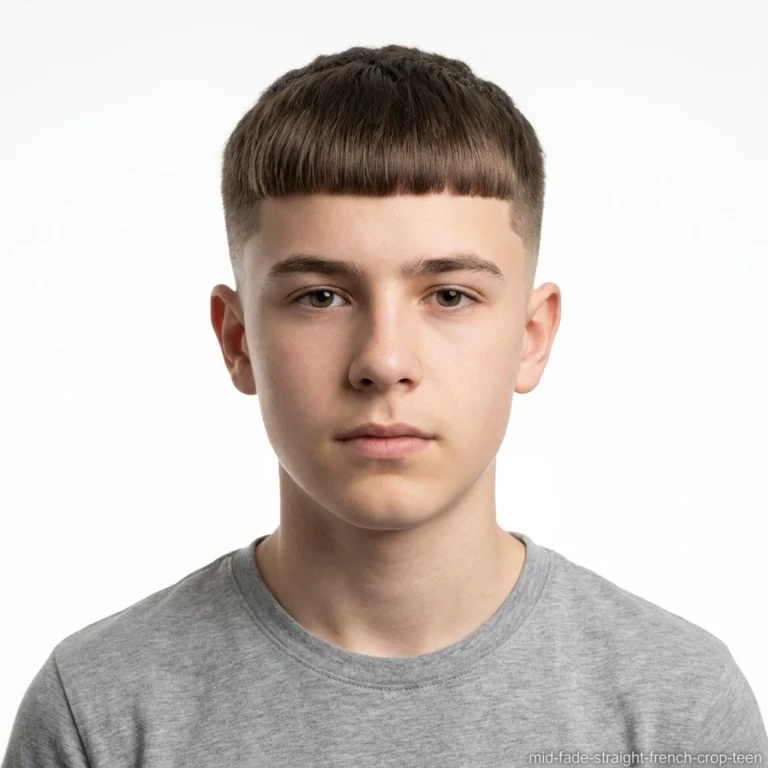
1. Mid Fade with Straight French Crop

teen boy with straight hair French crop and mid fade haircut

The French crop with a mid fade is a popular choice for teen boys with straight hair and it earns that popularity. The blunt fringe across the forehead it's flat and precise — straight hair doesn't blur the edge the way wavy or curly hair does — and the mid fade underneath creates a sharper visual separation between the sides and the top than a low fade would give. The result is clean, geometric, and deliberately styled without requiring any actual styling. Most straight-haired teens can walk out of the shower, let it air dry, and this cut looks exactly as intended.

The fringe length is the detail that matters most here. Too long — past the mid-forehead — and it starts reading as a bowl cut, which isn't the look. Too short and the fringe disappears into the top of the cut. The right length is just above or grazing the top of the eyebrows, which gives the French crop its characteristic frame without tipping over into the wrong territory. Maintenance is every 2 to 3 weeks for the fringe specifically — the mid fade can go a bit longer but the blunt fringe line loses precision quickly on straight hair as it grows evenly and fast.

Barber Tip: Ask your barber to cut the fringe with the comb held completely flat — even a slight angle reads clearly on straight hair. The mid fade here works best as a skin fade starting at the temple, which gives the sharpest possible contrast with the cropped top.

2. Mid Fade with Straight Hair Side Part

teen boy with straight hair side part and mid fade haircut

The hard part side part with a mid fade on straight hair it's a bit sharper and looks more polished look than most teens go for — which is exactly why it stands out most of the time. Straight hair is flat on both sides of the shaved part line without any need the hair to hold its direction, so the part reads with maximum clarity. The longer side sweeps across in a natural way and the shorter side drops into the mid fade cleanly. On straight dark hair the contrast between the parted top and the faded sides are very noticeable.

The hard part needs touching up every 10 to 14 days — straight hair grows evenly and the shaved line fills in at a predictable rate. The rest of the cut holds longer, around 3 to 4 weeks. Daily styling is minimal: a light cream or a small amount of pomade combed through the longer side on damp hair takes about 30 seconds and keeps everything in place. This cut works well for school dress codes that require a neat appearance and equally well for casual settings where it just reads as a well-groomed choice.

Barber Tip: Ask for a straight razor on the part line rather than a clipper — it gives a sharper edge that holds longer. The mid fade should be a skin fade on the shorter side for the cleanest contrast with the combed-over top.

3. Mid Fade with Straight Hair Quiff

teen boy with straight hair quiff and mid fade haircut

Straight hair builds a clean quiff with minimal effort and the mid fade underneath amplifies the effect considerably. The sides drop quickly from the temple, which creates a taller visual gap between the tight sides and the fuller top — making the quiff look more elevated and defined than it would with a low fade. On straight hair this is particularly effective because the strands run upward in clean parallel lines without any texture interrupting the direction. It's a structured look but not a stiff one. This is useful for teens who want something that looks intentional without looking like they tried too hard.

Styling takes only 2 to 3 minutes. On damp hair, put a small amount of matte clay through the top section with your fingers and push the front upward and a little bit slightly forward, Then either air dry or give it a quick blow dry to set the shape if you want more volume. Straight hair holds a blow-dried shape well throughout the day, so the morning routine is the only thing that you need.. Top length should sit around 3 to 3.5 inches — enough to build the quiff shape but not so much that the weight starts pulling it flat by lunchtime.

Barber Tip: Ask for the front section to be left a quarter inch longer than the rest of the top — this gives the quiff enough weight at the front to push forward naturally. The mid fade should start at the temple and blend with a 1 guard at the bottom for maximum contrast.

4. Mid Fade with Straight Hair Faux Hawk

teen boy with straight hair faux hawk and mid fade haircut

The faux hawk with a mid fade on straight hair is a bolder option. Straight hair handles it better than most other types because the center strip goes upward in clean. Also, precise lines without any curl or texture pulling it sideways. The mid fade on the sides drops quickly enough to create a wide visual gap between the faded sides and the center strip. It's a confident cut for sure. Not for everyone, but for the teen who wants something that makes a statement without being completely out of place at school, this is a reasonable choice.

Straight hair needs a medium-hold clay or fiber product to keep the center strip upright throughout the day — without product the hair gradually falls flat because there's no natural texture helping it hold its position. Apply on damp hair, concentrate it through the center section, push upward and pinch slightly along the ridge to define the strip, then let it air dry in position. Don't blow dry — straight hair responds too aggressively to heat and the faux hawk can end up looking wider and less defined than intended. The mid fade needs a touch-up every 2 weeks or the shape starts losing its impact.

Barber Tip: The center strip needs at least 2.5 to 3 inches of length for the faux hawk to stand convincingly on straight hair. Ask for the mid fade to drop to a 0 or 1 at the bottom — the clean lines of straight hair make a sharp fade particularly effective on this cut.

5. Mid Fade with Straight Hair Messy Top

teen boy with straight hair messy top and mid fade haircut

The messy top is the most casual option on this list and probably the most popular among teen boys who want a good haircut without committing to anything too structured. The top is left at a medium length — around 2.5 to 3.5 inches — and pushed loosely forward without any particular direction. The mid fade underneath does the heavy lifting which creates enough contrast with the loose top. On straight hair the strands fall in a consistent direction without clumping or frizzing, which gives the messiness a natural quality rather than a chaotic one.

Styling is genuinely minimal. A small amount of matte clay or a light sea salt spray on damp hair, worked through with the fingers in no particular direction, takes about 45 seconds. Don't comb it — the whole point is the slight randomness of where each section falls. Straight hair holds this style well through the day because the strands stay relatively flat rather than expanding or changing shape with humidity. The mid fade needs touching up every 2 to 3 weeks or the sides start blending into the top and the contrast that frames the messy style disappears.

Barber Tip: Ask for point-cutting or razor texturing on the top section — without it, straight hair sits as one flat uniform plane and the messy effect reads as just ungroomed rather than deliberately relaxed. Texturing at the ends creates the separation that makes this cut look intentional.

6. Mid Fade with Straight Curtain Hair

teen boy with straight curtain hair and mid fade haircut

Curtain hair with a mid fade on straight hair is one of the cleaner combinations on this list, particularly on dark straight hair where the contrast between the parted sections and the faded sides reads most sharply. The hair parts in the middle and falls to either side — on straight hair the sections lie flat and smooth rather than waving or curling outward, which gives the curtains a sleek, almost editorial quality. The mid fade underneath modernizes what would otherwise be a purely throwback style and creates enough contrast to make the longer top look intentional rather than just grown out.

The length needs to reach at least past the eyebrows — ideally to the cheekbone — for the curtain shape to develop properly. Shorter than that and there isn't enough length for the sections to fall convincingly to either side. Growing this out from a shorter cut means navigating an in-between phase around weeks 6 to 10 where the hair is long enough to be annoying but not quite long enough to part cleanly. Worth pushing through. A lightweight oil or a leave-in serum which is applied to slightly damp hair and then combed to either side of the part. It keeps the hair lying flat and prevents the frizz that can blur the curtain shape on straight hair in humid weather.

Barber Tip: Ask for the mid fade to start no higher than the temple so the longer curtain top has room to fall naturally. Tell your barber to blend gradually rather than dropping sharply — a soft transition suits the relaxed feel of curtain hair better than a hard fade line.

7. Mid Fade with Straight Hair Ivy League

teen boy with straight hair Ivy League cut and mid fade haircut

The Ivy League with a mid fade is the cut on this list that works best across the widest range of situations. School, a family event, sport photos, casual weekends — it doesn't need adjusting for any of them. The slight extra length at the front gives straight hair something to push forward or part to the side, while the mid fade creates a sharper separation between the top and sides than a traditional Ivy League with a taper would. On straight hair the front section lies flat with a natural direction rather than going in multiple ways at once, which makes the overall cut look consistently clean rather than just good on a good hair day.

This cut sits in a zone where straight hair looks dense and intentional without requiring any significant styling from you. A light cream or a matte clay pushed forward with the fingers on damp hair takes under a minute and holds all day. The mid fade needs touching up every 2 to 3 weeks. That's the complete maintenance requirement — one barber visit every few weeks and 45 seconds in the morning. For a teen who wants a solid cut that requires minimal effort, this is probably the strongest practical choice on the list.

Barber Tip: Ask for the top to be scissor-cut rather than clipped for a cleaner, denser-looking finish on straight hair. Leave 2 to 2.5 inches at the front and taper to about an inch at the crown — this gives the Ivy League its classic proportions without looking too formal.

8. Mid Fade with Straight Hair Edgar Cut

teen boy with straight hair Edgar cut and mid fade haircut

The Edgar cut is the most geometric option on this list — a flat top section with a sharp horizontal fringe line cut straight across, paired here with a mid fade on the sides. Straight hair is genuinely the best type for this cut because the fringe line holds with complete precision — no wave or curl blurring the edge, no texture softening the horizontal line. The mid fade drops the sides quickly from the temple, which creates a bold contrast with the flat, structured top. It's a statement cut. Some schools push back on it in dress code conversations, which is worth knowing before committing, but as a style statement on straight hair it's hard to argue with.

The fringe on an Edgar is cut completely flat and straight — the defining detail is the horizontal line, and any deviation from that reads as a mistake rather than a stylistic choice. Upkeep on this cut is real. The fringe needs trimming every 2 to 3 weeks or it starts softening and losing the precise geometric edge that makes the Edgar look intentional. The mid fade needs a touch-up on a similar schedule. Straight hair makes this easier than other hair types because the fringe grows evenly without developing texture that blurs the line, so each trim is straightforward.

Barber Tip: The fringe line on an Edgar must be cut with the comb held completely flat — check the line from directly in front before finishing. Ask your barber to use the mid fade as a skin fade starting at the temple, which creates the sharp contrast that makes the Edgar's flat top read as intentional rather than simply short.

9. Mid Fade with Straight Hair Slick Back

teen boy with straight hair slick back and mid fade haircut

The slick back with a mid fade is a more mature-looking choice for a teen, which depending on the situation is either exactly what you want or not what you're after. Straight hair goes back cleanly — no wave trying to reassert itself, no texture breaking up the surface — and the mid fade on the sides creates a sharper contrast than a low fade would, making the slicked top look more deliberate and structured. It's the kind of cut that reads well at a school formal, a family photo, or a job interview, but doesn't look out of place on a regular Tuesday either.

The top needs at least 3 to 3.5 inches for the slick back to lay back cleanly without the front section springing up. A light-hold pomade or a water-based product applied on damp hair and combed straight back is all it needs — straight hair doesn't require heavy product to stay in place because there's no opposing texture to fight. Heavy products on straight hair tend to look greasy rather than sleek, so less is genuinely more here. The mid fade needs a touch-up every 2 to 3 weeks or the sides grow in and the sharp contrast with the slicked top starts softening.

Barber Tip: Ask for the top to be left at 3.5 inches minimum and tell your barber you're planning to slick it back — they'll leave the front longest and taper slightly toward the crown, which helps the slick back hold its shape without the front popping up throughout the day.

10. Mid Fade with Straight Hair Textured Crop

teen boy with straight hair textured crop and mid fade haircut

The textured crop with a mid fade is the most versatile and consistently recommended cut on this list for teen boys with straight hair. The top sits at around an inch to an inch and a half, point-cut or razor-textured so the ends sit at slightly different angles rather than lying as one flat sheet. The mid fade underneath creates more contrast than a low fade would give — the sides drop to skin around the temple, which makes the textured top look fuller and more defined by comparison. It works at school, it works on weekends, it works everywhere without any adjustment needed between contexts.

The texturing step is more important on straight hair than on other types. Without it, a short crop on straight hair sits completely flat and featureless — just a dense block of hair with no visual interest. With proper point-cutting the ends break up and each section sits independently, which is what gives the crop its texture and movement. No daily product is required on most days — on days you want more definition a small amount of matte clay through the top takes 30 seconds. The mid fade needs touching up every 2 to 3 weeks on straight hair because clean growth lines are more visible on straight hair than on other types, and the fade starts looking grown out sooner.

Barber Tip: Ask specifically for point-cutting on the top section — this is the step that separates a good textured crop from a mediocre one on straight hair. Without it the cut loses its texture within a day or two of washing and goes back to looking flat and featureless.

Straight hair on a teen is one of the easier starting points a barber can work with, and a mid fade is one of the better tools to pair with it. The hair lies flat, blends cleanly, and holds the shape of a cut longer than most other hair types. The mid fade — starting around the temple and dropping down to the skin — creates a sharper contrast than a low fade but without the aggressiveness of a high fade. For school, sport, going out with friends, the mid fade sits in the right zone.

What makes this combination particularly good for teen boys is the flexibility. Straight hair with a mid fade works with minimal styling on casual days and cleans up quickly on days that require something more put-together. Most of the cuts on this list take a barber 30 to 40 minutes and hold their shape for 3 to 4 weeks. That's a decent return on one appointment. These 10 options cover the full range — from sharp and structured to relaxed and effortless — so there's something here regardless of personal style or school dress code.

1. Mid Fade with Straight French Crop

teen boy with straight hair French crop and mid fade haircut

The French crop with a mid fade is a popular choice for teen boys with straight hair and it earns that popularity. The blunt fringe across the forehead sits flat and precise — straight hair doesn't blur the edge the way wavy or curly hair does — and the mid fade underneath creates a sharper visual separation between the sides and the top than a low fade would give. The result is clean, geometric, and deliberately styled without requiring any actual styling. Most straight-haired teens can walk out of the shower, let it air dry, and this cut looks exactly as intended.

The fringe length is the detail that matters most here. Too long — past the mid-forehead — and it starts reading as a bowl cut, which isn't the look. Too short and the fringe disappears into the top of the cut. The right length is just above or grazing the top of the eyebrows, which gives the French crop its characteristic frame without tipping over into the wrong territory. Maintenance is every 2 to 3 weeks for the fringe specifically — the mid fade can go a bit longer but the blunt fringe line loses precision quickly on straight hair as it grows evenly and fast.

Barber Tip: Ask your barber to cut the fringe with the comb held completely flat — even a slight angle reads clearly on straight hair. The mid fade here works best as a skin fade starting at the temple, which gives the sharpest possible contrast with the cropped top.

2. Mid Fade with Straight Hair Side Part

teen boy with straight hair side part and mid fade haircut

The hard part side part with a mid fade on straight hair it's a bit sharper and looks more polished look than most teens go for — which is exactly why it stands out most of the time. Straight hair is flat on both sides of the shaved part line without any need the hair to hold its direction, so the part reads with maximum clarity. The longer side sweeps across in a natural way and the shorter side drops into the mid fade cleanly. On straight dark hair the contrast between the parted top and the faded sides are very noticeable.

The hard part needs touching up every 10 to 14 days — straight hair grows evenly and the shaved line fills in at a predictable rate. The rest of the cut holds longer, around 3 to 4 weeks. Daily styling is minimal: a light cream or a small amount of pomade combed through the longer side on damp hair takes about 30 seconds and keeps everything in place. This cut works well for school dress codes that require a neat appearance and equally well for casual settings where it just reads as a well-groomed choice.

Barber Tip: Ask for a straight razor on the part line rather than a clipper — it gives a sharper edge that holds longer. The mid fade should be a skin fade on the shorter side for the cleanest contrast with the combed-over top.

3. Mid Fade with Straight Hair Quiff

teen boy with straight hair quiff and mid fade haircut

Straight hair builds a clean quiff with minimal effort and the mid fade underneath amplifies the effect considerably. The sides drop quickly from the temple, which creates a taller visual gap between the tight sides and the fuller top — making the quiff look more elevated and defined than it would with a low fade. On straight hair this is particularly effective because the strands run upward in clean parallel lines without any texture interrupting the direction. It's a structured look but not a stiff one. This is useful for teens who want something that looks intentional without looking like they tried too hard.

Styling takes only 2 to 3 minutes. On damp hair, put a small amount of matte clay through the top section with your fingers and push the front upward and a little bit slightly forward, Then either air dry or give it a quick blow dry to set the shape if you want more volume. Straight hair holds a blow-dried shape well throughout the day, so the morning routine is the only thing that you need.. Top length should sit around 3 to 3.5 inches — enough to build the quiff shape but not so much that the weight starts pulling it flat by lunchtime.

Barber Tip: Ask for the front section to be left a quarter inch longer than the rest of the top — this gives the quiff enough weight at the front to push forward naturally. The mid fade should start at the temple and blend with a 1 guard at the bottom for maximum contrast.

4. Mid Fade with Straight Hair Faux Hawk

teen boy with straight hair faux hawk and mid fade haircut

The faux hawk with a mid fade on straight hair is a bolder option. Straight hair handles it better than most other types because the center strip goes upward in clean. Also, precise lines without any curl or texture pulling it sideways. The mid fade on the sides drops quickly enough to create a wide visual gap between the faded sides and the center strip. It's a confident cut for sure. Not for everyone, but for the teen who wants something that makes a statement without being completely out of place at school, this is a reasonable choice.

Straight hair needs a medium-hold clay or fiber product to keep the center strip upright throughout the day — without product the hair gradually falls flat because there's no natural texture helping it hold its position. Apply on damp hair, concentrate it through the center section, push upward and pinch slightly along the ridge to define the strip, then let it air dry in position. Don't blow dry — straight hair responds too aggressively to heat and the faux hawk can end up looking wider and less defined than intended. The mid fade needs a touch-up every 2 weeks or the shape starts losing its impact.

Barber Tip: The center strip needs at least 2.5 to 3 inches of length for the faux hawk to stand convincingly on straight hair. Ask for the mid fade to drop to a 0 or 1 at the bottom — the clean lines of straight hair make a sharp fade particularly effective on this cut.

5. Mid Fade with Straight Hair Messy Top

teen boy with straight hair messy top and mid fade haircut

The messy top is the most casual option on this list and probably the most popular among teen boys who want a good haircut without committing to anything too structured. The top is left at a medium length — around 2.5 to 3.5 inches — and pushed loosely forward without any particular direction. The mid fade underneath does the heavy lifting which creates enough contrast with the loose top. On straight hair the strands fall in a consistent direction without clumping or frizzing, which gives the messiness a natural quality rather than a chaotic one.

Styling is genuinely minimal. A small amount of matte clay or a light sea salt spray on damp hair, worked through with the fingers in no particular direction, takes about 45 seconds. Don't comb it — the whole point is the slight randomness of where each section falls. Straight hair holds this style well through the day because the strands stay relatively flat rather than expanding or changing shape with humidity. The mid fade needs touching up every 2 to 3 weeks or the sides start blending into the top and the contrast that frames the messy style disappears.

Barber Tip: Ask for point-cutting or razor texturing on the top section — without it, straight hair sits as one flat uniform plane and the messy effect reads as just ungroomed rather than deliberately relaxed. Texturing at the ends creates the separation that makes this cut look intentional.

6. Mid Fade with Straight Curtain Hair

teen boy with straight curtain hair and mid fade haircut

Curtain hair with a mid fade on straight hair is one of the cleaner combinations on this list, particularly on dark straight hair where the contrast between the parted sections and the faded sides reads most sharply. The hair parts in the middle and falls to either side — on straight hair the sections lie flat and smooth rather than waving or curling outward, which gives the curtains a sleek, almost editorial quality. The mid fade underneath modernizes what would otherwise be a purely throwback style and creates enough contrast to make the longer top look intentional rather than just grown out.

The length needs to reach at least past the eyebrows — ideally to the cheekbone — for the curtain shape to develop properly. Shorter than that and there isn't enough length for the sections to fall convincingly to either side. Growing this out from a shorter cut means navigating an in-between phase around weeks 6 to 10 where the hair is long enough to be annoying but not quite long enough to part cleanly. Worth pushing through. A lightweight oil or a leave-in serum which is applied to slightly damp hair and then combed to either side of the part. It keeps the hair lying flat and prevents the frizz that can blur the curtain shape on straight hair in humid weather.

Barber Tip: Ask for the mid fade to start no higher than the temple so the longer curtain top has room to fall naturally. Tell your barber to blend gradually rather than dropping sharply — a soft transition suits the relaxed feel of curtain hair better than a hard fade line.

7. Mid Fade with Straight Hair Ivy League

teen boy with straight hair Ivy League cut and mid fade haircut

The Ivy League with a mid fade is the cut on this list that works best across the widest range of situations. School, a family event, sport photos, casual weekends — it doesn't need adjusting for any of them. The slight extra length at the front gives straight hair something to push forward or part to the side, while the mid fade creates a sharper separation between the top and sides than a traditional Ivy League with a taper would. On straight hair the front section lies flat with a natural direction rather than going in multiple ways at once, which makes the overall cut look consistently clean rather than just good on a good hair day.

This cut sits in a zone where straight hair looks dense and intentional without requiring any significant styling from you. A light cream or a matte clay pushed forward with the fingers on damp hair takes under a minute and holds all day. The mid fade needs touching up every 2 to 3 weeks. That's the complete maintenance requirement — one barber visit every few weeks and 45 seconds in the morning. For a teen who wants a solid cut that requires minimal effort, this is probably the strongest practical choice on the list.

Barber Tip: Ask for the top to be scissor-cut rather than clipped for a cleaner, denser-looking finish on straight hair. Leave 2 to 2.5 inches at the front and taper to about an inch at the crown — this gives the Ivy League its classic proportions without looking too formal.

8. Mid Fade with Straight Hair Edgar Cut

teen boy with straight hair Edgar cut and mid fade haircut

The Edgar cut is the most geometric option on this list — a flat top section with a sharp horizontal fringe line cut straight across, paired here with a mid fade on the sides. Straight hair is genuinely the best type for this cut because the fringe line holds with complete precision — no wave or curl blurring the edge, no texture softening the horizontal line. The mid fade drops the sides quickly from the temple, which creates a bold contrast with the flat, structured top. It's a statement cut. Some schools push back on it in dress code conversations, which is worth knowing before committing, but as a style statement on straight hair it's hard to argue with.

The fringe on an Edgar is cut completely flat and straight — the defining detail is the horizontal line, and any deviation from that reads as a mistake rather than a stylistic choice. Upkeep on this cut is real. The fringe needs trimming every 2 to 3 weeks or it starts softening and losing the precise geometric edge that makes the Edgar look intentional. The mid fade needs a touch-up on a similar schedule. Straight hair makes this easier than other hair types because the fringe grows evenly without developing texture that blurs the line, so each trim is straightforward.

Barber Tip: The fringe line on an Edgar must be cut with the comb held completely flat — check the line from directly in front before finishing. Ask your barber to use the mid fade as a skin fade starting at the temple, which creates the sharp contrast that makes the Edgar's flat top read as intentional rather than simply short.

9. Mid Fade with Straight Hair Slick Back

teen boy with straight hair slick back and mid fade haircut

The slick back with a mid fade is a more mature-looking choice for a teen, which depending on the situation is either exactly what you want or not what you're after. Straight hair goes back cleanly — no wave trying to reassert itself, no texture breaking up the surface — and the mid fade on the sides creates a sharper contrast than a low fade would, making the slicked top look more deliberate and structured. It's the kind of cut that reads well at a school formal, a family photo, or a job interview, but doesn't look out of place on a regular Tuesday either.

The top needs at least 3 to 3.5 inches for the slick back to lay back cleanly without the front section springing up. A light-hold pomade or a water-based product applied on damp hair and combed straight back is all it needs — straight hair doesn't require heavy product to stay in place because there's no opposing texture to fight. Heavy products on straight hair tend to look greasy rather than sleek, so less is genuinely more here. The mid fade needs a touch-up every 2 to 3 weeks or the sides grow in and the sharp contrast with the slicked top starts softening.

Barber Tip: Ask for the top to be left at 3.5 inches minimum and tell your barber you're planning to slick it back — they'll leave the front longest and taper slightly toward the crown, which helps the slick back hold its shape without the front popping up throughout the day.

10. Mid Fade with Straight Hair Textured Crop

teen boy with straight hair textured crop and mid fade haircut

The textured crop with a mid fade is the most versatile and consistently recommended cut on this list for teen boys with straight hair. The top sits at around an inch to an inch and a half, point-cut or razor-textured so the ends sit at slightly different angles rather than lying as one flat sheet. The mid fade underneath creates more contrast than a low fade would give — the sides drop to skin around the temple, which makes the textured top look fuller and more defined by comparison. It works at school, it works on weekends, it works everywhere without any adjustment needed between contexts.

The texturing step is more important on straight hair than on other types. Without it, a short crop on straight hair sits completely flat and featureless — just a dense block of hair with no visual interest. With proper point-cutting the ends break up and each section sits independently, which is what gives the crop its texture and movement. No daily product is required on most days — on days you want more definition a small amount of matte clay through the top takes 30 seconds. The mid fade needs touching up every 2 to 3 weeks on straight hair because clean growth lines are more visible on straight hair than on other types, and the fade starts looking grown out sooner.

Barber Tip: Ask specifically for point-cutting on the top section — this is the step that separates a good textured crop from a mediocre one on straight hair. Without it the cut loses its texture within a day or two of washing and goes back to looking flat and featureless.

Straight hair on a teen is one of the easier starting points a barber can work with, and a mid fade is one of the better tools to pair with it. The hair lies flat, blends cleanly, and holds the shape of a cut longer than most other hair types. The mid fade — starting around the temple and dropping down to the skin — creates a sharper contrast than a low fade but without the aggressiveness of a high fade. For school, sport, going out with friends, the mid fade sits in the right zone.

What makes this combination particularly good for teen boys is the flexibility. Straight hair with a mid fade works with minimal styling on casual days and cleans up quickly on days that require something more put-together. Most of the cuts on this list take a barber 30 to 40 minutes and hold their shape for 3 to 4 weeks. That's a decent return on one appointment. These 10 options cover the full range — from sharp and structured to relaxed and effortless — so there's something here regardless of personal style or school dress code.

1. Mid Fade with Straight French Crop

teen boy with straight hair French crop and mid fade haircut

The French crop with a mid fade is a popular choice for teen boys with straight hair and it earns that popularity. The blunt fringe across the forehead sits flat and precise — straight hair doesn't blur the edge the way wavy or curly hair does — and the mid fade underneath creates a sharper visual separation between the sides and the top than a low fade would give. The result is clean, geometric, and deliberately styled without requiring any actual styling. Most straight-haired teens can walk out of the shower, let it air dry, and this cut looks exactly as intended.

The fringe length is the detail that matters most here. Too long — past the mid-forehead — and it starts reading as a bowl cut, which isn't the look. Too short and the fringe disappears into the top of the cut. The right length is just above or grazing the top of the eyebrows, which gives the French crop its characteristic frame without tipping over into the wrong territory. Maintenance is every 2 to 3 weeks for the fringe specifically — the mid fade can go a bit longer but the blunt fringe line loses precision quickly on straight hair as it grows evenly and fast.

Barber Tip: Ask your barber to cut the fringe with the comb held completely flat — even a slight angle reads clearly on straight hair. The mid fade here works best as a skin fade starting at the temple, which gives the sharpest possible contrast with the cropped top.

2. Mid Fade with Straight Hair Side Part

teen boy with straight hair side part and mid fade haircut

The hard part side part with a mid fade on straight hair it's a bit sharper and looks more polished look than most teens go for — which is exactly why it stands out most of the time. Straight hair is flat on both sides of the shaved part line without any need the hair to hold its direction, so the part reads with maximum clarity. The longer side sweeps across in a natural way and the shorter side drops into the mid fade cleanly. On straight dark hair the contrast between the parted top and the faded sides are very noticeable.

The hard part needs touching up every 10 to 14 days — straight hair grows evenly and the shaved line fills in at a predictable rate. The rest of the cut holds longer, around 3 to 4 weeks. Daily styling is minimal: a light cream or a small amount of pomade combed through the longer side on damp hair takes about 30 seconds and keeps everything in place. This cut works well for school dress codes that require a neat appearance and equally well for casual settings where it just reads as a well-groomed choice.

Barber Tip: Ask for a straight razor on the part line rather than a clipper — it gives a sharper edge that holds longer. The mid fade should be a skin fade on the shorter side for the cleanest contrast with the combed-over top.

3. Mid Fade with Straight Hair Quiff

teen boy with straight hair quiff and mid fade haircut

Straight hair builds a clean quiff with minimal effort and the mid fade underneath amplifies the effect considerably. The sides drop quickly from the temple, which creates a taller visual gap between the tight sides and the fuller top — making the quiff look more elevated and defined than it would with a low fade. On straight hair this is particularly effective because the strands run upward in clean parallel lines without any texture interrupting the direction. It's a structured look but not a stiff one. This is useful for teens who want something that looks intentional without looking like they tried too hard.

Styling takes only 2 to 3 minutes. On damp hair, put a small amount of matte clay through the top section with your fingers and push the front upward and a little bit slightly forward, Then either air dry or give it a quick blow dry to set the shape if you want more volume. Straight hair holds a blow-dried shape well throughout the day, so the morning routine is the only thing that you need.. Top length should sit around 3 to 3.5 inches — enough to build the quiff shape but not so much that the weight starts pulling it flat by lunchtime.

Barber Tip: Ask for the front section to be left a quarter inch longer than the rest of the top — this gives the quiff enough weight at the front to push forward naturally. The mid fade should start at the temple and blend with a 1 guard at the bottom for maximum contrast.

4. Mid Fade with Straight Hair Faux Hawk

teen boy with straight hair faux hawk and mid fade haircut

The faux hawk with a mid fade on straight hair is a bolder option. Straight hair handles it better than most other types because the center strip goes upward in clean. Also, precise lines without any curl or texture pulling it sideways. The mid fade on the sides drops quickly enough to create a wide visual gap between the faded sides and the center strip. It's a confident cut for sure. Not for everyone, but for the teen who wants something that makes a statement without being completely out of place at school, this is a reasonable choice.

Straight hair needs a medium-hold clay or fiber product to keep the center strip upright throughout the day — without product the hair gradually falls flat because there's no natural texture helping it hold its position. Apply on damp hair, concentrate it through the center section, push upward and pinch slightly along the ridge to define the strip, then let it air dry in position. Don't blow dry — straight hair responds too aggressively to heat and the faux hawk can end up looking wider and less defined than intended. The mid fade needs a touch-up every 2 weeks or the shape starts losing its impact.

Barber Tip: The center strip needs at least 2.5 to 3 inches of length for the faux hawk to stand convincingly on straight hair. Ask for the mid fade to drop to a 0 or 1 at the bottom — the clean lines of straight hair make a sharp fade particularly effective on this cut.

5. Mid Fade with Straight Hair Messy Top

teen boy with straight hair messy top and mid fade haircut

The messy top is the most casual option on this list and probably the most popular among teen boys who want a good haircut without committing to anything too structured. The top is left at a medium length — around 2.5 to 3.5 inches — and pushed loosely forward without any particular direction. The mid fade underneath does the heavy lifting which creates enough contrast with the loose top. On straight hair the strands fall in a consistent direction without clumping or frizzing, which gives the messiness a natural quality rather than a chaotic one.

Styling is genuinely minimal. A small amount of matte clay or a light sea salt spray on damp hair, worked through with the fingers in no particular direction, takes about 45 seconds. Don't comb it — the whole point is the slight randomness of where each section falls. Straight hair holds this style well through the day because the strands stay relatively flat rather than expanding or changing shape with humidity. The mid fade needs touching up every 2 to 3 weeks or the sides start blending into the top and the contrast that frames the messy style disappears.

Barber Tip: Ask for point-cutting or razor texturing on the top section — without it, straight hair sits as one flat uniform plane and the messy effect reads as just ungroomed rather than deliberately relaxed. Texturing at the ends creates the separation that makes this cut look intentional.

6. Mid Fade with Straight Curtain Hair

teen boy with straight curtain hair and mid fade haircut

Curtain hair with a mid fade on straight hair is one of the cleaner combinations on this list, particularly on dark straight hair where the contrast between the parted sections and the faded sides reads most sharply. The hair parts in the middle and falls to either side — on straight hair the sections lie flat and smooth rather than waving or curling outward, which gives the curtains a sleek, almost editorial quality. The mid fade underneath modernizes what would otherwise be a purely throwback style and creates enough contrast to make the longer top look intentional rather than just grown out.

The length needs to reach at least past the eyebrows — ideally to the cheekbone — for the curtain shape to develop properly. Shorter than that and there isn't enough length for the sections to fall convincingly to either side. Growing this out from a shorter cut means navigating an in-between phase around weeks 6 to 10 where the hair is long enough to be annoying but not quite long enough to part cleanly. Worth pushing through. A lightweight oil or a leave-in serum which is applied to slightly damp hair and then combed to either side of the part. It keeps the hair lying flat and prevents the frizz that can blur the curtain shape on straight hair in humid weather.

Barber Tip: Ask for the mid fade to start no higher than the temple so the longer curtain top has room to fall naturally. Tell your barber to blend gradually rather than dropping sharply — a soft transition suits the relaxed feel of curtain hair better than a hard fade line.

7. Mid Fade with Straight Hair Ivy League

teen boy with straight hair Ivy League cut and mid fade haircut

The Ivy League with a mid fade is the cut on this list that works best across the widest range of situations. School, a family event, sport photos, casual weekends — it doesn't need adjusting for any of them. The slight extra length at the front gives straight hair something to push forward or part to the side, while the mid fade creates a sharper separation between the top and sides than a traditional Ivy League with a taper would. On straight hair the front section lies flat with a natural direction rather than going in multiple ways at once, which makes the overall cut look consistently clean rather than just good on a good hair day.

This cut sits in a zone where straight hair looks dense and intentional without requiring any significant styling from you. A light cream or a matte clay pushed forward with the fingers on damp hair takes under a minute and holds all day. The mid fade needs touching up every 2 to 3 weeks. That's the complete maintenance requirement — one barber visit every few weeks and 45 seconds in the morning. For a teen who wants a solid cut that requires minimal effort, this is probably the strongest practical choice on the list.

Barber Tip: Ask for the top to be scissor-cut rather than clipped for a cleaner, denser-looking finish on straight hair. Leave 2 to 2.5 inches at the front and taper to about an inch at the crown — this gives the Ivy League its classic proportions without looking too formal.

8. Mid Fade with Straight Hair Edgar Cut

teen boy with straight hair Edgar cut and mid fade haircut

The Edgar cut is the most geometric option on this list — a flat top section with a sharp horizontal fringe line cut straight across, paired here with a mid fade on the sides. Straight hair is genuinely the best type for this cut because the fringe line holds with complete precision — no wave or curl blurring the edge, no texture softening the horizontal line. The mid fade drops the sides quickly from the temple, which creates a bold contrast with the flat, structured top. It's a statement cut. Some schools push back on it in dress code conversations, which is worth knowing before committing, but as a style statement on straight hair it's hard to argue with.

The fringe on an Edgar is cut completely flat and straight — the defining detail is the horizontal line, and any deviation from that reads as a mistake rather than a stylistic choice. Upkeep on this cut is real. The fringe needs trimming every 2 to 3 weeks or it starts softening and losing the precise geometric edge that makes the Edgar look intentional. The mid fade needs a touch-up on a similar schedule. Straight hair makes this easier than other hair types because the fringe grows evenly without developing texture that blurs the line, so each trim is straightforward.

Barber Tip: The fringe line on an Edgar must be cut with the comb held completely flat — check the line from directly in front before finishing. Ask your barber to use the mid fade as a skin fade starting at the temple, which creates the sharp contrast that makes the Edgar's flat top read as intentional rather than simply short.

9. Mid Fade with Straight Hair Slick Back

teen boy with straight hair slick back and mid fade haircut

The slick back with a mid fade is a more mature-looking choice for a teen, which depending on the situation is either exactly what you want or not what you're after. Straight hair goes back cleanly — no wave trying to reassert itself, no texture breaking up the surface — and the mid fade on the sides creates a sharper contrast than a low fade would, making the slicked top look more deliberate and structured. It's the kind of cut that reads well at a school formal, a family photo, or a job interview, but doesn't look out of place on a regular Tuesday either.

The top needs at least 3 to 3.5 inches for the slick back to lay back cleanly without the front section springing up. A light-hold pomade or a water-based product applied on damp hair and combed straight back is all it needs — straight hair doesn't require heavy product to stay in place because there's no opposing texture to fight. Heavy products on straight hair tend to look greasy rather than sleek, so less is genuinely more here. The mid fade needs a touch-up every 2 to 3 weeks or the sides grow in and the sharp contrast with the slicked top starts softening.

Barber Tip: Ask for the top to be left at 3.5 inches minimum and tell your barber you're planning to slick it back — they'll leave the front longest and taper slightly toward the crown, which helps the slick back hold its shape without the front popping up throughout the day.

10. Mid Fade with Straight Hair Textured Crop

teen boy with straight hair textured crop and mid fade haircut

The textured crop with a mid fade is the most versatile and consistently recommended cut on this list for teen boys with straight hair. The top sits at around an inch to an inch and a half, point-cut or razor-textured so the ends sit at slightly different angles rather than lying as one flat sheet. The mid fade underneath creates more contrast than a low fade would give — the sides drop to skin around the temple, which makes the textured top look fuller and more defined by comparison. It works at school, it works on weekends, it works everywhere without any adjustment needed between contexts.

The texturing step is more important on straight hair than on other types. Without it, a short crop on straight hair sits completely flat and featureless — just a dense block of hair with no visual interest. With proper point-cutting the ends break up and each section sits independently, which is what gives the crop its texture and movement. No daily product is required on most days — on days you want more definition a small amount of matte clay through the top takes 30 seconds. The mid fade needs touching up every 2 to 3 weeks on straight hair because clean growth lines are more visible on straight hair than on other types, and the fade starts looking grown out sooner.

Barber Tip: Ask specifically for point-cutting on the top section — this is the step that separates a good textured crop from a mediocre one on straight hair. Without it the cut loses its texture within a day or two of washing and goes back to looking flat and featureless.

Straight hair on a teen is one of the easier starting points a barber can work with, and a mid fade is one of the better tools to pair with it. The hair lies flat, blends cleanly, and holds the shape of a cut longer than most other hair types. The mid fade — starting around the temple and dropping down to the skin — creates a sharper contrast than a low fade but without the aggressiveness of a high fade. For school, sport, going out with friends, the mid fade sits in the right zone.

What makes this combination particularly good for teen boys is the flexibility. Straight hair with a mid fade works with minimal styling on casual days and cleans up quickly on days that require something more put-together. Most of the cuts on this list take a barber 30 to 40 minutes and hold their shape for 3 to 4 weeks. That's a decent return on one appointment. These 10 options cover the full range — from sharp and structured to relaxed and effortless — so there's something here regardless of personal style or school dress code.

1. Mid Fade with Straight French Crop

teen boy with straight hair French crop and mid fade haircut

The French crop with a mid fade is a popular choice for teen boys with straight hair and it earns that popularity. The blunt fringe across the forehead sits flat and precise — straight hair doesn't blur the edge the way wavy or curly hair does — and the mid fade underneath creates a sharper visual separation between the sides and the top than a low fade would give. The result is clean, geometric, and deliberately styled without requiring any actual styling. Most straight-haired teens can walk out of the shower, let it air dry, and this cut looks exactly as intended.

The fringe length is the detail that matters most here. Too long — past the mid-forehead — and it starts reading as a bowl cut, which isn't the look. Too short and the fringe disappears into the top of the cut. The right length is just above or grazing the top of the eyebrows, which gives the French crop its characteristic frame without tipping over into the wrong territory. Maintenance is every 2 to 3 weeks for the fringe specifically — the mid fade can go a bit longer but the blunt fringe line loses precision quickly on straight hair as it grows evenly and fast.

Barber Tip: Ask your barber to cut the fringe with the comb held completely flat — even a slight angle reads clearly on straight hair. The mid fade here works best as a skin fade starting at the temple, which gives the sharpest possible contrast with the cropped top.

2. Mid Fade with Straight Hair Side Part

teen boy with straight hair side part and mid fade haircut

The hard part side part with a mid fade on straight hair it's a bit sharper and looks more polished look than most teens go for — which is exactly why it stands out most of the time. Straight hair is flat on both sides of the shaved part line without any need the hair to hold its direction, so the part reads with maximum clarity. The longer side sweeps across in a natural way and the shorter side drops into the mid fade cleanly. On straight dark hair the contrast between the parted top and the faded sides are very noticeable.

The hard part needs touching up every 10 to 14 days — straight hair grows evenly and the shaved line fills in at a predictable rate. The rest of the cut holds longer, around 3 to 4 weeks. Daily styling is minimal: a light cream or a small amount of pomade combed through the longer side on damp hair takes about 30 seconds and keeps everything in place. This cut works well for school dress codes that require a neat appearance and equally well for casual settings where it just reads as a well-groomed choice.

Barber Tip: Ask for a straight razor on the part line rather than a clipper — it gives a sharper edge that holds longer. The mid fade should be a skin fade on the shorter side for the cleanest contrast with the combed-over top.

3. Mid Fade with Straight Hair Quiff

teen boy with straight hair quiff and mid fade haircut

Straight hair builds a clean quiff with minimal effort and the mid fade underneath amplifies the effect considerably. The sides drop quickly from the temple, which creates a taller visual gap between the tight sides and the fuller top — making the quiff look more elevated and defined than it would with a low fade. On straight hair this is particularly effective because the strands run upward in clean parallel lines without any texture interrupting the direction. It's a structured look but not a stiff one. This is useful for teens who want something that looks intentional without looking like they tried too hard.

Styling takes only 2 to 3 minutes. On damp hair, put a small amount of matte clay through the top section with your fingers and push the front upward and a little bit slightly forward, Then either air dry or give it a quick blow dry to set the shape if you want more volume. Straight hair holds a blow-dried shape well throughout the day, so the morning routine is the only thing that you need.. Top length should sit around 3 to 3.5 inches — enough to build the quiff shape but not so much that the weight starts pulling it flat by lunchtime.

Barber Tip: Ask for the front section to be left a quarter inch longer than the rest of the top — this gives the quiff enough weight at the front to push forward naturally. The mid fade should start at the temple and blend with a 1 guard at the bottom for maximum contrast.

4. Mid Fade with Straight Hair Faux Hawk

teen boy with straight hair faux hawk and mid fade haircut

The faux hawk with a mid fade on straight hair is a bolder option. Straight hair handles it better than most other types because the center strip goes upward in clean. Also, precise lines without any curl or texture pulling it sideways. The mid fade on the sides drops quickly enough to create a wide visual gap between the faded sides and the center strip. It's a confident cut for sure. Not for everyone, but for the teen who wants something that makes a statement without being completely out of place at school, this is a reasonable choice.

Straight hair needs a medium-hold clay or fiber product to keep the center strip upright throughout the day — without product the hair gradually falls flat because there's no natural texture helping it hold its position. Apply on damp hair, concentrate it through the center section, push upward and pinch slightly along the ridge to define the strip, then let it air dry in position. Don't blow dry — straight hair responds too aggressively to heat and the faux hawk can end up looking wider and less defined than intended. The mid fade needs a touch-up every 2 weeks or the shape starts losing its impact.

Barber Tip: The center strip needs at least 2.5 to 3 inches of length for the faux hawk to stand convincingly on straight hair. Ask for the mid fade to drop to a 0 or 1 at the bottom — the clean lines of straight hair make a sharp fade particularly effective on this cut.

5. Mid Fade with Straight Hair Messy Top

teen boy with straight hair messy top and mid fade haircut

The messy top is the most casual option on this list and probably the most popular among teen boys who want a good haircut without committing to anything too structured. The top is left at a medium length — around 2.5 to 3.5 inches — and pushed loosely forward without any particular direction. The mid fade underneath does the heavy lifting which creates enough contrast with the loose top. On straight hair the strands fall in a consistent direction without clumping or frizzing, which gives the messiness a natural quality rather than a chaotic one.

Styling is genuinely minimal. A small amount of matte clay or a light sea salt spray on damp hair, worked through with the fingers in no particular direction, takes about 45 seconds. Don't comb it — the whole point is the slight randomness of where each section falls. Straight hair holds this style well through the day because the strands stay relatively flat rather than expanding or changing shape with humidity. The mid fade needs touching up every 2 to 3 weeks or the sides start blending into the top and the contrast that frames the messy style disappears.

Barber Tip: Ask for point-cutting or razor texturing on the top section — without it, straight hair sits as one flat uniform plane and the messy effect reads as just ungroomed rather than deliberately relaxed. Texturing at the ends creates the separation that makes this cut look intentional.

6. Mid Fade with Straight Curtain Hair

teen boy with straight curtain hair and mid fade haircut

Curtain hair with a mid fade on straight hair is one of the cleaner combinations on this list, particularly on dark straight hair where the contrast between the parted sections and the faded sides reads most sharply. The hair parts in the middle and falls to either side — on straight hair the sections lie flat and smooth rather than waving or curling outward, which gives the curtains a sleek, almost editorial quality. The mid fade underneath modernizes what would otherwise be a purely throwback style and creates enough contrast to make the longer top look intentional rather than just grown out.

The length needs to reach at least past the eyebrows — ideally to the cheekbone — for the curtain shape to develop properly. Shorter than that and there isn't enough length for the sections to fall convincingly to either side. Growing this out from a shorter cut means navigating an in-between phase around weeks 6 to 10 where the hair is long enough to be annoying but not quite long enough to part cleanly. Worth pushing through. A lightweight oil or a leave-in serum which is applied to slightly damp hair and then combed to either side of the part. It keeps the hair lying flat and prevents the frizz that can blur the curtain shape on straight hair in humid weather.

Barber Tip: Ask for the mid fade to start no higher than the temple so the longer curtain top has room to fall naturally. Tell your barber to blend gradually rather than dropping sharply — a soft transition suits the relaxed feel of curtain hair better than a hard fade line.

7. Mid Fade with Straight Hair Ivy League

teen boy with straight hair Ivy League cut and mid fade haircut

The Ivy League with a mid fade is the cut on this list that works best across the widest range of situations. School, a family event, sport photos, casual weekends — it doesn't need adjusting for any of them. The slight extra length at the front gives straight hair something to push forward or part to the side, while the mid fade creates a sharper separation between the top and sides than a traditional Ivy League with a taper would. On straight hair the front section lies flat with a natural direction rather than going in multiple ways at once, which makes the overall cut look consistently clean rather than just good on a good hair day.

This cut sits in a zone where straight hair looks dense and intentional without requiring any significant styling from you. A light cream or a matte clay pushed forward with the fingers on damp hair takes under a minute and holds all day. The mid fade needs touching up every 2 to 3 weeks. That's the complete maintenance requirement — one barber visit every few weeks and 45 seconds in the morning. For a teen who wants a solid cut that requires minimal effort, this is probably the strongest practical choice on the list.

Barber Tip: Ask for the top to be scissor-cut rather than clipped for a cleaner, denser-looking finish on straight hair. Leave 2 to 2.5 inches at the front and taper to about an inch at the crown — this gives the Ivy League its classic proportions without looking too formal.

8. Mid Fade with Straight Hair Edgar Cut

teen boy with straight hair Edgar cut and mid fade haircut

The Edgar cut is the most geometric option on this list — a flat top section with a sharp horizontal fringe line cut straight across, paired here with a mid fade on the sides. Straight hair is genuinely the best type for this cut because the fringe line holds with complete precision — no wave or curl blurring the edge, no texture softening the horizontal line. The mid fade drops the sides quickly from the temple, which creates a bold contrast with the flat, structured top. It's a statement cut. Some schools push back on it in dress code conversations, which is worth knowing before committing, but as a style statement on straight hair it's hard to argue with.

The fringe on an Edgar is cut completely flat and straight — the defining detail is the horizontal line, and any deviation from that reads as a mistake rather than a stylistic choice. Upkeep on this cut is real. The fringe needs trimming every 2 to 3 weeks or it starts softening and losing the precise geometric edge that makes the Edgar look intentional. The mid fade needs a touch-up on a similar schedule. Straight hair makes this easier than other hair types because the fringe grows evenly without developing texture that blurs the line, so each trim is straightforward.

Barber Tip: The fringe line on an Edgar must be cut with the comb held completely flat — check the line from directly in front before finishing. Ask your barber to use the mid fade as a skin fade starting at the temple, which creates the sharp contrast that makes the Edgar's flat top read as intentional rather than simply short.

9. Mid Fade with Straight Hair Slick Back

teen boy with straight hair slick back and mid fade haircut

The slick back with a mid fade is a more mature-looking choice for a teen, which depending on the situation is either exactly what you want or not what you're after. Straight hair goes back cleanly — no wave trying to reassert itself, no texture breaking up the surface — and the mid fade on the sides creates a sharper contrast than a low fade would, making the slicked top look more deliberate and structured. It's the kind of cut that reads well at a school formal, a family photo, or a job interview, but doesn't look out of place on a regular Tuesday either.

The top needs at least 3 to 3.5 inches for the slick back to lay back cleanly without the front section springing up. A light-hold pomade or a water-based product applied on damp hair and combed straight back is all it needs — straight hair doesn't require heavy product to stay in place because there's no opposing texture to fight. Heavy products on straight hair tend to look greasy rather than sleek, so less is genuinely more here. The mid fade needs a touch-up every 2 to 3 weeks or the sides grow in and the sharp contrast with the slicked top starts softening.

Barber Tip: Ask for the top to be left at 3.5 inches minimum and tell your barber you're planning to slick it back — they'll leave the front longest and taper slightly toward the crown, which helps the slick back hold its shape without the front popping up throughout the day.

10. Mid Fade with Straight Hair Textured Crop

teen boy with straight hair textured crop and mid fade haircut

The textured crop with a mid fade is the most versatile and consistently recommended cut on this list for teen boys with straight hair. The top sits at around an inch to an inch and a half, point-cut or razor-textured so the ends sit at slightly different angles rather than lying as one flat sheet. The mid fade underneath creates more contrast than a low fade would give — the sides drop to skin around the temple, which makes the textured top look fuller and more defined by comparison. It works at school, it works on weekends, it works everywhere without any adjustment needed between contexts.

The texturing step is more important on straight hair than on other types. Without it, a short crop on straight hair sits completely flat and featureless — just a dense block of hair with no visual interest. With proper point-cutting the ends break up and each section sits independently, which is what gives the crop its texture and movement. No daily product is required on most days — on days you want more definition a small amount of matte clay through the top takes 30 seconds. The mid fade needs touching up every 2 to 3 weeks on straight hair because clean growth lines are more visible on straight hair than on other types, and the fade starts looking grown out sooner.

Barber Tip: Ask specifically for point-cutting on the top section — this is the step that separates a good textured crop from a mediocre one on straight hair. Without it the cut loses its texture within a day or two of washing and goes back to looking flat and featureless.

Straight hair on a teen is one of the easier starting points a barber can work with, and a mid fade is one of the better tools to pair with it. The hair lies flat, blends cleanly, and holds the shape of a cut longer than most other hair types. The mid fade — starting around the temple and dropping down to the skin — creates a sharper contrast than a low fade but without the aggressiveness of a high fade. For school, sport, going out with friends, the mid fade sits in the right zone.

What makes this combination particularly good for teen boys is the flexibility. Straight hair with a mid fade works with minimal styling on casual days and cleans up quickly on days that require something more put-together. Most of the cuts on this list take a barber 30 to 40 minutes and hold their shape for 3 to 4 weeks. That's a decent return on one appointment. These 10 options cover the full range — from sharp and structured to relaxed and effortless — so there's something here regardless of personal style or school dress code.

1. Mid Fade with Straight French Crop

teen boy with straight hair French crop and mid fade haircut

The French crop with a mid fade is a popular choice for teen boys with straight hair and it earns that popularity. The blunt fringe across the forehead sits flat and precise — straight hair doesn't blur the edge the way wavy or curly hair does — and the mid fade underneath creates a sharper visual separation between the sides and the top than a low fade would give. The result is clean, geometric, and deliberately styled without requiring any actual styling. Most straight-haired teens can walk out of the shower, let it air dry, and this cut looks exactly as intended.

The fringe length is the detail that matters most here. Too long — past the mid-forehead — and it starts reading as a bowl cut, which isn't the look. Too short and the fringe disappears into the top of the cut. The right length is just above or grazing the top of the eyebrows, which gives the French crop its characteristic frame without tipping over into the wrong territory. Maintenance is every 2 to 3 weeks for the fringe specifically — the mid fade can go a bit longer but the blunt fringe line loses precision quickly on straight hair as it grows evenly and fast.

Barber Tip: Ask your barber to cut the fringe with the comb held completely flat — even a slight angle reads clearly on straight hair. The mid fade here works best as a skin fade starting at the temple, which gives the sharpest possible contrast with the cropped top.

2. Mid Fade with Straight Hair Side Part

teen boy with straight hair side part and mid fade haircut

The hard part side part with a mid fade on straight hair it's a bit sharper and looks more polished look than most teens go for — which is exactly why it stands out most of the time. Straight hair is flat on both sides of the shaved part line without any need the hair to hold its direction, so the part reads with maximum clarity. The longer side sweeps across in a natural way and the shorter side drops into the mid fade cleanly. On straight dark hair the contrast between the parted top and the faded sides are very noticeable.

The hard part needs touching up every 10 to 14 days — straight hair grows evenly and the shaved line fills in at a predictable rate. The rest of the cut holds longer, around 3 to 4 weeks. Daily styling is minimal: a light cream or a small amount of pomade combed through the longer side on damp hair takes about 30 seconds and keeps everything in place. This cut works well for school dress codes that require a neat appearance and equally well for casual settings where it just reads as a well-groomed choice.

Barber Tip: Ask for a straight razor on the part line rather than a clipper — it gives a sharper edge that holds longer. The mid fade should be a skin fade on the shorter side for the cleanest contrast with the combed-over top.

3. Mid Fade with Straight Hair Quiff

teen boy with straight hair quiff and mid fade haircut

Straight hair builds a clean quiff with minimal effort and the mid fade underneath amplifies the effect considerably. The sides drop quickly from the temple, which creates a taller visual gap between the tight sides and the fuller top — making the quiff look more elevated and defined than it would with a low fade. On straight hair this is particularly effective because the strands run upward in clean parallel lines without any texture interrupting the direction. It's a structured look but not a stiff one. This is useful for teens who want something that looks intentional without looking like they tried too hard.

Styling takes only 2 to 3 minutes. On damp hair, put a small amount of matte clay through the top section with your fingers and push the front upward and a little bit slightly forward, Then either air dry or give it a quick blow dry to set the shape if you want more volume. Straight hair holds a blow-dried shape well throughout the day, so the morning routine is the only thing that you need.. Top length should sit around 3 to 3.5 inches — enough to build the quiff shape but not so much that the weight starts pulling it flat by lunchtime.

Barber Tip: Ask for the front section to be left a quarter inch longer than the rest of the top — this gives the quiff enough weight at the front to push forward naturally. The mid fade should start at the temple and blend with a 1 guard at the bottom for maximum contrast.

4. Mid Fade with Straight Hair Faux Hawk

teen boy with straight hair faux hawk and mid fade haircut

The faux hawk with a mid fade on straight hair is a bolder option. Straight hair handles it better than most other types because the center strip goes upward in clean. Also, precise lines without any curl or texture pulling it sideways. The mid fade on the sides drops quickly enough to create a wide visual gap between the faded sides and the center strip. It's a confident cut for sure. Not for everyone, but for the teen who wants something that makes a statement without being completely out of place at school, this is a reasonable choice.

Straight hair needs a medium-hold clay or fiber product to keep the center strip upright throughout the day — without product the hair gradually falls flat because there's no natural texture helping it hold its position. Apply on damp hair, concentrate it through the center section, push upward and pinch slightly along the ridge to define the strip, then let it air dry in position. Don't blow dry — straight hair responds too aggressively to heat and the faux hawk can end up looking wider and less defined than intended. The mid fade needs a touch-up every 2 weeks or the shape starts losing its impact.

Barber Tip: The center strip needs at least 2.5 to 3 inches of length for the faux hawk to stand convincingly on straight hair. Ask for the mid fade to drop to a 0 or 1 at the bottom — the clean lines of straight hair make a sharp fade particularly effective on this cut.

5. Mid Fade with Straight Hair Messy Top

teen boy with straight hair messy top and mid fade haircut

The messy top is the most casual option on this list and probably the most popular among teen boys who want a good haircut without committing to anything too structured. The top is left at a medium length — around 2.5 to 3.5 inches — and pushed loosely forward without any particular direction. The mid fade underneath does the heavy lifting which creates enough contrast with the loose top. On straight hair the strands fall in a consistent direction without clumping or frizzing, which gives the messiness a natural quality rather than a chaotic one.

Styling is genuinely minimal. A small amount of matte clay or a light sea salt spray on damp hair, worked through with the fingers in no particular direction, takes about 45 seconds. Don't comb it — the whole point is the slight randomness of where each section falls. Straight hair holds this style well through the day because the strands stay relatively flat rather than expanding or changing shape with humidity. The mid fade needs touching up every 2 to 3 weeks or the sides start blending into the top and the contrast that frames the messy style disappears.

Barber Tip: Ask for point-cutting or razor texturing on the top section — without it, straight hair sits as one flat uniform plane and the messy effect reads as just ungroomed rather than deliberately relaxed. Texturing at the ends creates the separation that makes this cut look intentional.

6. Mid Fade with Straight Curtain Hair

teen boy with straight curtain hair and mid fade haircut

Curtain hair with a mid fade on straight hair is one of the cleaner combinations on this list, particularly on dark straight hair where the contrast between the parted sections and the faded sides reads most sharply. The hair parts in the middle and falls to either side — on straight hair the sections lie flat and smooth rather than waving or curling outward, which gives the curtains a sleek, almost editorial quality. The mid fade underneath modernizes what would otherwise be a purely throwback style and creates enough contrast to make the longer top look intentional rather than just grown out.

The length needs to reach at least past the eyebrows — ideally to the cheekbone — for the curtain shape to develop properly. Shorter than that and there isn't enough length for the sections to fall convincingly to either side. Growing this out from a shorter cut means navigating an in-between phase around weeks 6 to 10 where the hair is long enough to be annoying but not quite long enough to part cleanly. Worth pushing through. A lightweight oil or a leave-in serum which is applied to slightly damp hair and then combed to either side of the part. It keeps the hair lying flat and prevents the frizz that can blur the curtain shape on straight hair in humid weather.

Barber Tip: Ask for the mid fade to start no higher than the temple so the longer curtain top has room to fall naturally. Tell your barber to blend gradually rather than dropping sharply — a soft transition suits the relaxed feel of curtain hair better than a hard fade line.

7. Mid Fade with Straight Hair Ivy League

teen boy with straight hair Ivy League cut and mid fade haircut

The Ivy League with a mid fade is the cut on this list that works best across the widest range of situations. School, a family event, sport photos, casual weekends — it doesn't need adjusting for any of them. The slight extra length at the front gives straight hair something to push forward or part to the side, while the mid fade creates a sharper separation between the top and sides than a traditional Ivy League with a taper would. On straight hair the front section lies flat with a natural direction rather than going in multiple ways at once, which makes the overall cut look consistently clean rather than just good on a good hair day.

This cut sits in a zone where straight hair looks dense and intentional without requiring any significant styling from you. A light cream or a matte clay pushed forward with the fingers on damp hair takes under a minute and holds all day. The mid fade needs touching up every 2 to 3 weeks. That's the complete maintenance requirement — one barber visit every few weeks and 45 seconds in the morning. For a teen who wants a solid cut that requires minimal effort, this is probably the strongest practical choice on the list.

Barber Tip: Ask for the top to be scissor-cut rather than clipped for a cleaner, denser-looking finish on straight hair. Leave 2 to 2.5 inches at the front and taper to about an inch at the crown — this gives the Ivy League its classic proportions without looking too formal.

8. Mid Fade with Straight Hair Edgar Cut

teen boy with straight hair Edgar cut and mid fade haircut

The Edgar cut is the most geometric option on this list — a flat top section with a sharp horizontal fringe line cut straight across, paired here with a mid fade on the sides. Straight hair is genuinely the best type for this cut because the fringe line holds with complete precision — no wave or curl blurring the edge, no texture softening the horizontal line. The mid fade drops the sides quickly from the temple, which creates a bold contrast with the flat, structured top. It's a statement cut. Some schools push back on it in dress code conversations, which is worth knowing before committing, but as a style statement on straight hair it's hard to argue with.

The fringe on an Edgar is cut completely flat and straight — the defining detail is the horizontal line, and any deviation from that reads as a mistake rather than a stylistic choice. Upkeep on this cut is real. The fringe needs trimming every 2 to 3 weeks or it starts softening and losing the precise geometric edge that makes the Edgar look intentional. The mid fade needs a touch-up on a similar schedule. Straight hair makes this easier than other hair types because the fringe grows evenly without developing texture that blurs the line, so each trim is straightforward.

Barber Tip: The fringe line on an Edgar must be cut with the comb held completely flat — check the line from directly in front before finishing. Ask your barber to use the mid fade as a skin fade starting at the temple, which creates the sharp contrast that makes the Edgar's flat top read as intentional rather than simply short.

9. Mid Fade with Straight Hair Slick Back

teen boy with straight hair slick back and mid fade haircut

The slick back with a mid fade is a more mature-looking choice for a teen, which depending on the situation is either exactly what you want or not what you're after. Straight hair goes back cleanly — no wave trying to reassert itself, no texture breaking up the surface — and the mid fade on the sides creates a sharper contrast than a low fade would, making the slicked top look more deliberate and structured. It's the kind of cut that reads well at a school formal, a family photo, or a job interview, but doesn't look out of place on a regular Tuesday either.

The top needs at least 3 to 3.5 inches for the slick back to lay back cleanly without the front section springing up. A light-hold pomade or a water-based product applied on damp hair and combed straight back is all it needs — straight hair doesn't require heavy product to stay in place because there's no opposing texture to fight. Heavy products on straight hair tend to look greasy rather than sleek, so less is genuinely more here. The mid fade needs a touch-up every 2 to 3 weeks or the sides grow in and the sharp contrast with the slicked top starts softening.

Barber Tip: Ask for the top to be left at 3.5 inches minimum and tell your barber you're planning to slick it back — they'll leave the front longest and taper slightly toward the crown, which helps the slick back hold its shape without the front popping up throughout the day.

10. Mid Fade with Straight Hair Textured Crop

teen boy with straight hair textured crop and mid fade haircut

The textured crop with a mid fade is the most versatile and consistently recommended cut on this list for teen boys with straight hair. The top sits at around an inch to an inch and a half, point-cut or razor-textured so the ends sit at slightly different angles rather than lying as one flat sheet. The mid fade underneath creates more contrast than a low fade would give — the sides drop to skin around the temple, which makes the textured top look fuller and more defined by comparison. It works at school, it works on weekends, it works everywhere without any adjustment needed between contexts.

The texturing step is more important on straight hair than on other types. Without it, a short crop on straight hair sits completely flat and featureless — just a dense block of hair with no visual interest. With proper point-cutting the ends break up and each section sits independently, which is what gives the crop its texture and movement. No daily product is required on most days — on days you want more definition a small amount of matte clay through the top takes 30 seconds. The mid fade needs touching up every 2 to 3 weeks on straight hair because clean growth lines are more visible on straight hair than on other types, and the fade starts looking grown out sooner.

Barber Tip: Ask specifically for point-cutting on the top section — this is the step that separates a good textured crop from a mediocre one on straight hair. Without it the cut loses its texture within a day or two of washing and goes back to looking flat and featureless.

Straight hair on a teen is one of the easier starting points a barber can work with, and a mid fade is one of the better tools to pair with it. The hair lies flat, blends cleanly, and holds the shape of a cut longer than most other hair types. The mid fade — starting around the temple and dropping down to the skin — creates a sharper contrast than a low fade but without the aggressiveness of a high fade. For school, sport, going out with friends, the mid fade sits in the right zone.

What makes this combination particularly good for teen boys is the flexibility. Straight hair with a mid fade works with minimal styling on casual days and cleans up quickly on days that require something more put-together. Most of the cuts on this list take a barber 30 to 40 minutes and hold their shape for 3 to 4 weeks. That's a decent return on one appointment. These 10 options cover the full range — from sharp and structured to relaxed and effortless — so there's something here regardless of personal style or school dress code.

1. Mid Fade with Straight French Crop

teen boy with straight hair French crop and mid fade haircut

The French crop with a mid fade is a popular choice for teen boys with straight hair and it earns that popularity. The blunt fringe across the forehead sits flat and precise — straight hair doesn't blur the edge the way wavy or curly hair does — and the mid fade underneath creates a sharper visual separation between the sides and the top than a low fade would give. The result is clean, geometric, and deliberately styled without requiring any actual styling. Most straight-haired teens can walk out of the shower, let it air dry, and this cut looks exactly as intended.

The fringe length is the detail that matters most here. Too long — past the mid-forehead — and it starts reading as a bowl cut, which isn't the look. Too short and the fringe disappears into the top of the cut. The right length is just above or grazing the top of the eyebrows, which gives the French crop its characteristic frame without tipping over into the wrong territory. Maintenance is every 2 to 3 weeks for the fringe specifically — the mid fade can go a bit longer but the blunt fringe line loses precision quickly on straight hair as it grows evenly and fast.

Barber Tip: Ask your barber to cut the fringe with the comb held completely flat — even a slight angle reads clearly on straight hair. The mid fade here works best as a skin fade starting at the temple, which gives the sharpest possible contrast with the cropped top.

2. Mid Fade with Straight Hair Side Part

teen boy with straight hair side part and mid fade haircut

The hard part side part with a mid fade on straight hair it's a bit sharper and looks more polished look than most teens go for — which is exactly why it stands out most of the time. Straight hair is flat on both sides of the shaved part line without any need the hair to hold its direction, so the part reads with maximum clarity. The longer side sweeps across in a natural way and the shorter side drops into the mid fade cleanly. On straight dark hair the contrast between the parted top and the faded sides are very noticeable.

The hard part needs touching up every 10 to 14 days — straight hair grows evenly and the shaved line fills in at a predictable rate. The rest of the cut holds longer, around 3 to 4 weeks. Daily styling is minimal: a light cream or a small amount of pomade combed through the longer side on damp hair takes about 30 seconds and keeps everything in place. This cut works well for school dress codes that require a neat appearance and equally well for casual settings where it just reads as a well-groomed choice.

Barber Tip: Ask for a straight razor on the part line rather than a clipper — it gives a sharper edge that holds longer. The mid fade should be a skin fade on the shorter side for the cleanest contrast with the combed-over top.

3. Mid Fade with Straight Hair Quiff

teen boy with straight hair quiff and mid fade haircut

Straight hair builds a clean quiff with minimal effort and the mid fade underneath amplifies the effect considerably. The sides drop quickly from the temple, which creates a taller visual gap between the tight sides and the fuller top — making the quiff look more elevated and defined than it would with a low fade. On straight hair this is particularly effective because the strands run upward in clean parallel lines without any texture interrupting the direction. It's a structured look but not a stiff one. This is useful for teens who want something that looks intentional without looking like they tried too hard.

Styling takes only 2 to 3 minutes. On damp hair, put a small amount of matte clay through the top section with your fingers and push the front upward and a little bit slightly forward, Then either air dry or give it a quick blow dry to set the shape if you want more volume. Straight hair holds a blow-dried shape well throughout the day, so the morning routine is the only thing that you need.. Top length should sit around 3 to 3.5 inches — enough to build the quiff shape but not so much that the weight starts pulling it flat by lunchtime.

Barber Tip: Ask for the front section to be left a quarter inch longer than the rest of the top — this gives the quiff enough weight at the front to push forward naturally. The mid fade should start at the temple and blend with a 1 guard at the bottom for maximum contrast.

4. Mid Fade with Straight Hair Faux Hawk

teen boy with straight hair faux hawk and mid fade haircut

The faux hawk with a mid fade on straight hair is a bolder option. Straight hair handles it better than most other types because the center strip goes upward in clean. Also, precise lines without any curl or texture pulling it sideways. The mid fade on the sides drops quickly enough to create a wide visual gap between the faded sides and the center strip. It's a confident cut for sure. Not for everyone, but for the teen who wants something that makes a statement without being completely out of place at school, this is a reasonable choice.

Straight hair needs a medium-hold clay or fiber product to keep the center strip upright throughout the day — without product the hair gradually falls flat because there's no natural texture helping it hold its position. Apply on damp hair, concentrate it through the center section, push upward and pinch slightly along the ridge to define the strip, then let it air dry in position. Don't blow dry — straight hair responds too aggressively to heat and the faux hawk can end up looking wider and less defined than intended. The mid fade needs a touch-up every 2 weeks or the shape starts losing its impact.

Barber Tip: The center strip needs at least 2.5 to 3 inches of length for the faux hawk to stand convincingly on straight hair. Ask for the mid fade to drop to a 0 or 1 at the bottom — the clean lines of straight hair make a sharp fade particularly effective on this cut.

5. Mid Fade with Straight Hair Messy Top

teen boy with straight hair messy top and mid fade haircut

The messy top is the most casual option on this list and probably the most popular among teen boys who want a good haircut without committing to anything too structured. The top is left at a medium length — around 2.5 to 3.5 inches — and pushed loosely forward without any particular direction. The mid fade underneath does the heavy lifting which creates enough contrast with the loose top. On straight hair the strands fall in a consistent direction without clumping or frizzing, which gives the messiness a natural quality rather than a chaotic one.

Styling is genuinely minimal. A small amount of matte clay or a light sea salt spray on damp hair, worked through with the fingers in no particular direction, takes about 45 seconds. Don't comb it — the whole point is the slight randomness of where each section falls. Straight hair holds this style well through the day because the strands stay relatively flat rather than expanding or changing shape with humidity. The mid fade needs touching up every 2 to 3 weeks or the sides start blending into the top and the contrast that frames the messy style disappears.

Barber Tip: Ask for point-cutting or razor texturing on the top section — without it, straight hair sits as one flat uniform plane and the messy effect reads as just ungroomed rather than deliberately relaxed. Texturing at the ends creates the separation that makes this cut look intentional.

6. Mid Fade with Straight Curtain Hair

teen boy with straight curtain hair and mid fade haircut

Curtain hair with a mid fade on straight hair is one of the cleaner combinations on this list, particularly on dark straight hair where the contrast between the parted sections and the faded sides reads most sharply. The hair parts in the middle and falls to either side — on straight hair the sections lie flat and smooth rather than waving or curling outward, which gives the curtains a sleek, almost editorial quality. The mid fade underneath modernizes what would otherwise be a purely throwback style and creates enough contrast to make the longer top look intentional rather than just grown out.

The length needs to reach at least past the eyebrows — ideally to the cheekbone — for the curtain shape to develop properly. Shorter than that and there isn't enough length for the sections to fall convincingly to either side. Growing this out from a shorter cut means navigating an in-between phase around weeks 6 to 10 where the hair is long enough to be annoying but not quite long enough to part cleanly. Worth pushing through. A lightweight oil or a leave-in serum which is applied to slightly damp hair and then combed to either side of the part. It keeps the hair lying flat and prevents the frizz that can blur the curtain shape on straight hair in humid weather.

Barber Tip: Ask for the mid fade to start no higher than the temple so the longer curtain top has room to fall naturally. Tell your barber to blend gradually rather than dropping sharply — a soft transition suits the relaxed feel of curtain hair better than a hard fade line.

7. Mid Fade with Straight Hair Ivy League

teen boy with straight hair Ivy League cut and mid fade haircut

The Ivy League with a mid fade is the cut on this list that works best across the widest range of situations. School, a family event, sport photos, casual weekends — it doesn't need adjusting for any of them. The slight extra length at the front gives straight hair something to push forward or part to the side, while the mid fade creates a sharper separation between the top and sides than a traditional Ivy League with a taper would. On straight hair the front section lies flat with a natural direction rather than going in multiple ways at once, which makes the overall cut look consistently clean rather than just good on a good hair day.

This cut sits in a zone where straight hair looks dense and intentional without requiring any significant styling from you. A light cream or a matte clay pushed forward with the fingers on damp hair takes under a minute and holds all day. The mid fade needs touching up every 2 to 3 weeks. That's the complete maintenance requirement — one barber visit every few weeks and 45 seconds in the morning. For a teen who wants a solid cut that requires minimal effort, this is probably the strongest practical choice on the list.

Barber Tip: Ask for the top to be scissor-cut rather than clipped for a cleaner, denser-looking finish on straight hair. Leave 2 to 2.5 inches at the front and taper to about an inch at the crown — this gives the Ivy League its classic proportions without looking too formal.

8. Mid Fade with Straight Hair Edgar Cut

teen boy with straight hair Edgar cut and mid fade haircut

The Edgar cut is the most geometric option on this list — a flat top section with a sharp horizontal fringe line cut straight across, paired here with a mid fade on the sides. Straight hair is genuinely the best type for this cut because the fringe line holds with complete precision — no wave or curl blurring the edge, no texture softening the horizontal line. The mid fade drops the sides quickly from the temple, which creates a bold contrast with the flat, structured top. It's a statement cut. Some schools push back on it in dress code conversations, which is worth knowing before committing, but as a style statement on straight hair it's hard to argue with.

The fringe on an Edgar is cut completely flat and straight — the defining detail is the horizontal line, and any deviation from that reads as a mistake rather than a stylistic choice. Upkeep on this cut is real. The fringe needs trimming every 2 to 3 weeks or it starts softening and losing the precise geometric edge that makes the Edgar look intentional. The mid fade needs a touch-up on a similar schedule. Straight hair makes this easier than other hair types because the fringe grows evenly without developing texture that blurs the line, so each trim is straightforward.

Barber Tip: The fringe line on an Edgar must be cut with the comb held completely flat — check the line from directly in front before finishing. Ask your barber to use the mid fade as a skin fade starting at the temple, which creates the sharp contrast that makes the Edgar's flat top read as intentional rather than simply short.

9. Mid Fade with Straight Hair Slick Back

teen boy with straight hair slick back and mid fade haircut

The slick back with a mid fade is a more mature-looking choice for a teen, which depending on the situation is either exactly what you want or not what you're after. Straight hair goes back cleanly — no wave trying to reassert itself, no texture breaking up the surface — and the mid fade on the sides creates a sharper contrast than a low fade would, making the slicked top look more deliberate and structured. It's the kind of cut that reads well at a school formal, a family photo, or a job interview, but doesn't look out of place on a regular Tuesday either.

The top needs at least 3 to 3.5 inches for the slick back to lay back cleanly without the front section springing up. A light-hold pomade or a water-based product applied on damp hair and combed straight back is all it needs — straight hair doesn't require heavy product to stay in place because there's no opposing texture to fight. Heavy products on straight hair tend to look greasy rather than sleek, so less is genuinely more here. The mid fade needs a touch-up every 2 to 3 weeks or the sides grow in and the sharp contrast with the slicked top starts softening.

Barber Tip: Ask for the top to be left at 3.5 inches minimum and tell your barber you're planning to slick it back — they'll leave the front longest and taper slightly toward the crown, which helps the slick back hold its shape without the front popping up throughout the day.

10. Mid Fade with Straight Hair Textured Crop

teen boy with straight hair textured crop and mid fade haircut

The textured crop with a mid fade is the most versatile and consistently recommended cut on this list for teen boys with straight hair. The top sits at around an inch to an inch and a half, point-cut or razor-textured so the ends sit at slightly different angles rather than lying as one flat sheet. The mid fade underneath creates more contrast than a low fade would give — the sides drop to skin around the temple, which makes the textured top look fuller and more defined by comparison. It works at school, it works on weekends, it works everywhere without any adjustment needed between contexts.

The texturing step is more important on straight hair than on other types. Without it, a short crop on straight hair sits completely flat and featureless — just a dense block of hair with no visual interest. With proper point-cutting the ends break up and each section sits independently, which is what gives the crop its texture and movement. No daily product is required on most days — on days you want more definition a small amount of matte clay through the top takes 30 seconds. The mid fade needs touching up every 2 to 3 weeks on straight hair because clean growth lines are more visible on straight hair than on other types, and the fade starts looking grown out sooner.

Barber Tip: Ask specifically for point-cutting on the top section — this is the step that separates a good textured crop from a mediocre one on straight hair. Without it the cut loses its texture within a day or two of washing and goes back to looking flat and featureless.

Straight hair on a teen is one of the easier starting points a barber can work with, and a mid fade is one of the better tools to pair with it. The hair lies flat, blends cleanly, and holds the shape of a cut longer than most other hair types. The mid fade — starting around the temple and dropping down to the skin — creates a sharper contrast than a low fade but without the aggressiveness of a high fade. For school, sport, going out with friends, the mid fade sits in the right zone.

What makes this combination particularly good for teen boys is the flexibility. Straight hair with a mid fade works with minimal styling on casual days and cleans up quickly on days that require something more put-together. Most of the cuts on this list take a barber 30 to 40 minutes and hold their shape for 3 to 4 weeks. That's a decent return on one appointment. These 10 options cover the full range — from sharp and structured to relaxed and effortless — so there's something here regardless of personal style or school dress code.

1. Mid Fade with Straight French Crop

teen boy with straight hair French crop and mid fade haircut

The French crop with a mid fade is a popular choice for teen boys with straight hair and it earns that popularity. The blunt fringe across the forehead sits flat and precise — straight hair doesn't blur the edge the way wavy or curly hair does — and the mid fade underneath creates a sharper visual separation between the sides and the top than a low fade would give. The result is clean, geometric, and deliberately styled without requiring any actual styling. Most straight-haired teens can walk out of the shower, let it air dry, and this cut looks exactly as intended.

The fringe length is the detail that matters most here. Too long — past the mid-forehead — and it starts reading as a bowl cut, which isn't the look. Too short and the fringe disappears into the top of the cut. The right length is just above or grazing the top of the eyebrows, which gives the French crop its characteristic frame without tipping over into the wrong territory. Maintenance is every 2 to 3 weeks for the fringe specifically — the mid fade can go a bit longer but the blunt fringe line loses precision quickly on straight hair as it grows evenly and fast.

Barber Tip: Ask your barber to cut the fringe with the comb held completely flat — even a slight angle reads clearly on straight hair. The mid fade here works best as a skin fade starting at the temple, which gives the sharpest possible contrast with the cropped top.

2. Mid Fade with Straight Hair Side Part

teen boy with straight hair side part and mid fade haircut

The hard part side part with a mid fade on straight hair it's a bit sharper and looks more polished look than most teens go for — which is exactly why it stands out most of the time. Straight hair is flat on both sides of the shaved part line without any need the hair to hold its direction, so the part reads with maximum clarity. The longer side sweeps across in a natural way and the shorter side drops into the mid fade cleanly. On straight dark hair the contrast between the parted top and the faded sides are very noticeable.

The hard part needs touching up every 10 to 14 days — straight hair grows evenly and the shaved line fills in at a predictable rate. The rest of the cut holds longer, around 3 to 4 weeks. Daily styling is minimal: a light cream or a small amount of pomade combed through the longer side on damp hair takes about 30 seconds and keeps everything in place. This cut works well for school dress codes that require a neat appearance and equally well for casual settings where it just reads as a well-groomed choice.

Barber Tip: Ask for a straight razor on the part line rather than a clipper — it gives a sharper edge that holds longer. The mid fade should be a skin fade on the shorter side for the cleanest contrast with the combed-over top.

3. Mid Fade with Straight Hair Quiff

teen boy with straight hair quiff and mid fade haircut

Straight hair builds a clean quiff with minimal effort and the mid fade underneath amplifies the effect considerably. The sides drop quickly from the temple, which creates a taller visual gap between the tight sides and the fuller top — making the quiff look more elevated and defined than it would with a low fade. On straight hair this is particularly effective because the strands run upward in clean parallel lines without any texture interrupting the direction. It's a structured look but not a stiff one. This is useful for teens who want something that looks intentional without looking like they tried too hard.

Styling takes only 2 to 3 minutes. On damp hair, put a small amount of matte clay through the top section with your fingers and push the front upward and a little bit slightly forward, Then either air dry or give it a quick blow dry to set the shape if you want more volume. Straight hair holds a blow-dried shape well throughout the day, so the morning routine is the only thing that you need.. Top length should sit around 3 to 3.5 inches — enough to build the quiff shape but not so much that the weight starts pulling it flat by lunchtime.

Barber Tip: Ask for the front section to be left a quarter inch longer than the rest of the top — this gives the quiff enough weight at the front to push forward naturally. The mid fade should start at the temple and blend with a 1 guard at the bottom for maximum contrast.

4. Mid Fade with Straight Hair Faux Hawk

teen boy with straight hair faux hawk and mid fade haircut

The faux hawk with a mid fade on straight hair is a bolder option. Straight hair handles it better than most other types because the center strip goes upward in clean. Also, precise lines without any curl or texture pulling it sideways. The mid fade on the sides drops quickly enough to create a wide visual gap between the faded sides and the center strip. It's a confident cut for sure. Not for everyone, but for the teen who wants something that makes a statement without being completely out of place at school, this is a reasonable choice.

Straight hair needs a medium-hold clay or fiber product to keep the center strip upright throughout the day — without product the hair gradually falls flat because there's no natural texture helping it hold its position. Apply on damp hair, concentrate it through the center section, push upward and pinch slightly along the ridge to define the strip, then let it air dry in position. Don't blow dry — straight hair responds too aggressively to heat and the faux hawk can end up looking wider and less defined than intended. The mid fade needs a touch-up every 2 weeks or the shape starts losing its impact.

Barber Tip: The center strip needs at least 2.5 to 3 inches of length for the faux hawk to stand convincingly on straight hair. Ask for the mid fade to drop to a 0 or 1 at the bottom — the clean lines of straight hair make a sharp fade particularly effective on this cut.

5. Mid Fade with Straight Hair Messy Top

teen boy with straight hair messy top and mid fade haircut

The messy top is the most casual option on this list and probably the most popular among teen boys who want a good haircut without committing to anything too structured. The top is left at a medium length — around 2.5 to 3.5 inches — and pushed loosely forward without any particular direction. The mid fade underneath does the heavy lifting which creates enough contrast with the loose top. On straight hair the strands fall in a consistent direction without clumping or frizzing, which gives the messiness a natural quality rather than a chaotic one.

Styling is genuinely minimal. A small amount of matte clay or a light sea salt spray on damp hair, worked through with the fingers in no particular direction, takes about 45 seconds. Don't comb it — the whole point is the slight randomness of where each section falls. Straight hair holds this style well through the day because the strands stay relatively flat rather than expanding or changing shape with humidity. The mid fade needs touching up every 2 to 3 weeks or the sides start blending into the top and the contrast that frames the messy style disappears.

Barber Tip: Ask for point-cutting or razor texturing on the top section — without it, straight hair sits as one flat uniform plane and the messy effect reads as just ungroomed rather than deliberately relaxed. Texturing at the ends creates the separation that makes this cut look intentional.

6. Mid Fade with Straight Curtain Hair

teen boy with straight curtain hair and mid fade haircut

Curtain hair with a mid fade on straight hair is one of the cleaner combinations on this list, particularly on dark straight hair where the contrast between the parted sections and the faded sides reads most sharply. The hair parts in the middle and falls to either side — on straight hair the sections lie flat and smooth rather than waving or curling outward, which gives the curtains a sleek, almost editorial quality. The mid fade underneath modernizes what would otherwise be a purely throwback style and creates enough contrast to make the longer top look intentional rather than just grown out.

The length needs to reach at least past the eyebrows — ideally to the cheekbone — for the curtain shape to develop properly. Shorter than that and there isn't enough length for the sections to fall convincingly to either side. Growing this out from a shorter cut means navigating an in-between phase around weeks 6 to 10 where the hair is long enough to be annoying but not quite long enough to part cleanly. Worth pushing through. A lightweight oil or a leave-in serum which is applied to slightly damp hair and then combed to either side of the part. It keeps the hair lying flat and prevents the frizz that can blur the curtain shape on straight hair in humid weather.

Barber Tip: Ask for the mid fade to start no higher than the temple so the longer curtain top has room to fall naturally. Tell your barber to blend gradually rather than dropping sharply — a soft transition suits the relaxed feel of curtain hair better than a hard fade line.

7. Mid Fade with Straight Hair Ivy League

teen boy with straight hair Ivy League cut and mid fade haircut

The Ivy League with a mid fade is the cut on this list that works best across the widest range of situations. School, a family event, sport photos, casual weekends — it doesn't need adjusting for any of them. The slight extra length at the front gives straight hair something to push forward or part to the side, while the mid fade creates a sharper separation between the top and sides than a traditional Ivy League with a taper would. On straight hair the front section lies flat with a natural direction rather than going in multiple ways at once, which makes the overall cut look consistently clean rather than just good on a good hair day.

This cut sits in a zone where straight hair looks dense and intentional without requiring any significant styling from you. A light cream or a matte clay pushed forward with the fingers on damp hair takes under a minute and holds all day. The mid fade needs touching up every 2 to 3 weeks. That's the complete maintenance requirement — one barber visit every few weeks and 45 seconds in the morning. For a teen who wants a solid cut that requires minimal effort, this is probably the strongest practical choice on the list.

Barber Tip: Ask for the top to be scissor-cut rather than clipped for a cleaner, denser-looking finish on straight hair. Leave 2 to 2.5 inches at the front and taper to about an inch at the crown — this gives the Ivy League its classic proportions without looking too formal.

8. Mid Fade with Straight Hair Edgar Cut

teen boy with straight hair Edgar cut and mid fade haircut

The Edgar cut is the most geometric option on this list — a flat top section with a sharp horizontal fringe line cut straight across, paired here with a mid fade on the sides. Straight hair is genuinely the best type for this cut because the fringe line holds with complete precision — no wave or curl blurring the edge, no texture softening the horizontal line. The mid fade drops the sides quickly from the temple, which creates a bold contrast with the flat, structured top. It's a statement cut. Some schools push back on it in dress code conversations, which is worth knowing before committing, but as a style statement on straight hair it's hard to argue with.

The fringe on an Edgar is cut completely flat and straight — the defining detail is the horizontal line, and any deviation from that reads as a mistake rather than a stylistic choice. Upkeep on this cut is real. The fringe needs trimming every 2 to 3 weeks or it starts softening and losing the precise geometric edge that makes the Edgar look intentional. The mid fade needs a touch-up on a similar schedule. Straight hair makes this easier than other hair types because the fringe grows evenly without developing texture that blurs the line, so each trim is straightforward.

Barber Tip: The fringe line on an Edgar must be cut with the comb held completely flat — check the line from directly in front before finishing. Ask your barber to use the mid fade as a skin fade starting at the temple, which creates the sharp contrast that makes the Edgar's flat top read as intentional rather than simply short.

9. Mid Fade with Straight Hair Slick Back

teen boy with straight hair slick back and mid fade haircut

The slick back with a mid fade is a more mature-looking choice for a teen, which depending on the situation is either exactly what you want or not what you're after. Straight hair goes back cleanly — no wave trying to reassert itself, no texture breaking up the surface — and the mid fade on the sides creates a sharper contrast than a low fade would, making the slicked top look more deliberate and structured. It's the kind of cut that reads well at a school formal, a family photo, or a job interview, but doesn't look out of place on a regular Tuesday either.

The top needs at least 3 to 3.5 inches for the slick back to lay back cleanly without the front section springing up. A light-hold pomade or a water-based product applied on damp hair and combed straight back is all it needs — straight hair doesn't require heavy product to stay in place because there's no opposing texture to fight. Heavy products on straight hair tend to look greasy rather than sleek, so less is genuinely more here. The mid fade needs a touch-up every 2 to 3 weeks or the sides grow in and the sharp contrast with the slicked top starts softening.

Barber Tip: Ask for the top to be left at 3.5 inches minimum and tell your barber you're planning to slick it back — they'll leave the front longest and taper slightly toward the crown, which helps the slick back hold its shape without the front popping up throughout the day.

10. Mid Fade with Straight Hair Textured Crop

teen boy with straight hair textured crop and mid fade haircut

The textured crop with a mid fade is the most versatile and consistently recommended cut on this list for teen boys with straight hair. The top sits at around an inch to an inch and a half, point-cut or razor-textured so the ends sit at slightly different angles rather than lying as one flat sheet. The mid fade underneath creates more contrast than a low fade would give — the sides drop to skin around the temple, which makes the textured top look fuller and more defined by comparison. It works at school, it works on weekends, it works everywhere without any adjustment needed between contexts.

The texturing step is more important on straight hair than on other types. Without it, a short crop on straight hair sits completely flat and featureless — just a dense block of hair with no visual interest. With proper point-cutting the ends break up and each section sits independently, which is what gives the crop its texture and movement. No daily product is required on most days — on days you want more definition a small amount of matte clay through the top takes 30 seconds. The mid fade needs touching up every 2 to 3 weeks on straight hair because clean growth lines are more visible on straight hair than on other types, and the fade starts looking grown out sooner.

Barber Tip: Ask specifically for point-cutting on the top section — this is the step that separates a good textured crop from a mediocre one on straight hair. Without it the cut loses its texture within a day or two of washing and goes back to looking flat and featureless.

Straight hair on a teen is one of the easier starting points a barber can work with, and a mid fade is one of the better tools to pair with it. The hair lies flat, blends cleanly, and holds the shape of a cut longer than most other hair types. The mid fade — starting around the temple and dropping down to the skin — creates a sharper contrast than a low fade but without the aggressiveness of a high fade. For school, sport, going out with friends, the mid fade sits in the right zone.

What makes this combination particularly good for teen boys is the flexibility. Straight hair with a mid fade works with minimal styling on casual days and cleans up quickly on days that require something more put-together. Most of the cuts on this list take a barber 30 to 40 minutes and hold their shape for 3 to 4 weeks. That's a decent return on one appointment. These 10 options cover the full range — from sharp and structured to relaxed and effortless — so there's something here regardless of personal style or school dress code.

1. Mid Fade with Straight French Crop

teen boy with straight hair French crop and mid fade haircut

The French crop with a mid fade is a popular choice for teen boys with straight hair and it earns that popularity. The blunt fringe across the forehead sits flat and precise — straight hair doesn't blur the edge the way wavy or curly hair does — and the mid fade underneath creates a sharper visual separation between the sides and the top than a low fade would give. The result is clean, geometric, and deliberately styled without requiring any actual styling. Most straight-haired teens can walk out of the shower, let it air dry, and this cut looks exactly as intended.

The fringe length is the detail that matters most here. Too long — past the mid-forehead — and it starts reading as a bowl cut, which isn't the look. Too short and the fringe disappears into the top of the cut. The right length is just above or grazing the top of the eyebrows, which gives the French crop its characteristic frame without tipping over into the wrong territory. Maintenance is every 2 to 3 weeks for the fringe specifically — the mid fade can go a bit longer but the blunt fringe line loses precision quickly on straight hair as it grows evenly and fast.

Barber Tip: Ask your barber to cut the fringe with the comb held completely flat — even a slight angle reads clearly on straight hair. The mid fade here works best as a skin fade starting at the temple, which gives the sharpest possible contrast with the cropped top.

2. Mid Fade with Straight Hair Side Part

teen boy with straight hair side part and mid fade haircut

The hard part side part with a mid fade on straight hair it's a bit sharper and looks more polished look than most teens go for — which is exactly why it stands out most of the time. Straight hair is flat on both sides of the shaved part line without any need the hair to hold its direction, so the part reads with maximum clarity. The longer side sweeps across in a natural way and the shorter side drops into the mid fade cleanly. On straight dark hair the contrast between the parted top and the faded sides are very noticeable.

The hard part needs touching up every 10 to 14 days — straight hair grows evenly and the shaved line fills in at a predictable rate. The rest of the cut holds longer, around 3 to 4 weeks. Daily styling is minimal: a light cream or a small amount of pomade combed through the longer side on damp hair takes about 30 seconds and keeps everything in place. This cut works well for school dress codes that require a neat appearance and equally well for casual settings where it just reads as a well-groomed choice.

Barber Tip: Ask for a straight razor on the part line rather than a clipper — it gives a sharper edge that holds longer. The mid fade should be a skin fade on the shorter side for the cleanest contrast with the combed-over top.

3. Mid Fade with Straight Hair Quiff

teen boy with straight hair quiff and mid fade haircut

Straight hair builds a clean quiff with minimal effort and the mid fade underneath amplifies the effect considerably. The sides drop quickly from the temple, which creates a taller visual gap between the tight sides and the fuller top — making the quiff look more elevated and defined than it would with a low fade. On straight hair this is particularly effective because the strands run upward in clean parallel lines without any texture interrupting the direction. It's a structured look but not a stiff one. This is useful for teens who want something that looks intentional without looking like they tried too hard.

Styling takes only 2 to 3 minutes. On damp hair, put a small amount of matte clay through the top section with your fingers and push the front upward and a little bit slightly forward, Then either air dry or give it a quick blow dry to set the shape if you want more volume. Straight hair holds a blow-dried shape well throughout the day, so the morning routine is the only thing that you need.. Top length should sit around 3 to 3.5 inches — enough to build the quiff shape but not so much that the weight starts pulling it flat by lunchtime.

Barber Tip: Ask for the front section to be left a quarter inch longer than the rest of the top — this gives the quiff enough weight at the front to push forward naturally. The mid fade should start at the temple and blend with a 1 guard at the bottom for maximum contrast.

4. Mid Fade with Straight Hair Faux Hawk

teen boy with straight hair faux hawk and mid fade haircut

The faux hawk with a mid fade on straight hair is a bolder option. Straight hair handles it better than most other types because the center strip goes upward in clean. Also, precise lines without any curl or texture pulling it sideways. The mid fade on the sides drops quickly enough to create a wide visual gap between the faded sides and the center strip. It's a confident cut for sure. Not for everyone, but for the teen who wants something that makes a statement without being completely out of place at school, this is a reasonable choice.

Straight hair needs a medium-hold clay or fiber product to keep the center strip upright throughout the day — without product the hair gradually falls flat because there's no natural texture helping it hold its position. Apply on damp hair, concentrate it through the center section, push upward and pinch slightly along the ridge to define the strip, then let it air dry in position. Don't blow dry — straight hair responds too aggressively to heat and the faux hawk can end up looking wider and less defined than intended. The mid fade needs a touch-up every 2 weeks or the shape starts losing its impact.

Barber Tip: The center strip needs at least 2.5 to 3 inches of length for the faux hawk to stand convincingly on straight hair. Ask for the mid fade to drop to a 0 or 1 at the bottom — the clean lines of straight hair make a sharp fade particularly effective on this cut.

5. Mid Fade with Straight Hair Messy Top

teen boy with straight hair messy top and mid fade haircut

The messy top is the most casual option on this list and probably the most popular among teen boys who want a good haircut without committing to anything too structured. The top is left at a medium length — around 2.5 to 3.5 inches — and pushed loosely forward without any particular direction. The mid fade underneath does the heavy lifting which creates enough contrast with the loose top. On straight hair the strands fall in a consistent direction without clumping or frizzing, which gives the messiness a natural quality rather than a chaotic one.

Styling is genuinely minimal. A small amount of matte clay or a light sea salt spray on damp hair, worked through with the fingers in no particular direction, takes about 45 seconds. Don't comb it — the whole point is the slight randomness of where each section falls. Straight hair holds this style well through the day because the strands stay relatively flat rather than expanding or changing shape with humidity. The mid fade needs touching up every 2 to 3 weeks or the sides start blending into the top and the contrast that frames the messy style disappears.

Barber Tip: Ask for point-cutting or razor texturing on the top section — without it, straight hair sits as one flat uniform plane and the messy effect reads as just ungroomed rather than deliberately relaxed. Texturing at the ends creates the separation that makes this cut look intentional.

6. Mid Fade with Straight Curtain Hair

teen boy with straight curtain hair and mid fade haircut

Curtain hair with a mid fade on straight hair is one of the cleaner combinations on this list, particularly on dark straight hair where the contrast between the parted sections and the faded sides reads most sharply. The hair parts in the middle and falls to either side — on straight hair the sections lie flat and smooth rather than waving or curling outward, which gives the curtains a sleek, almost editorial quality. The mid fade underneath modernizes what would otherwise be a purely throwback style and creates enough contrast to make the longer top look intentional rather than just grown out.

The length needs to reach at least past the eyebrows — ideally to the cheekbone — for the curtain shape to develop properly. Shorter than that and there isn't enough length for the sections to fall convincingly to either side. Growing this out from a shorter cut means navigating an in-between phase around weeks 6 to 10 where the hair is long enough to be annoying but not quite long enough to part cleanly. Worth pushing through. A lightweight oil or a leave-in serum which is applied to slightly damp hair and then combed to either side of the part. It keeps the hair lying flat and prevents the frizz that can blur the curtain shape on straight hair in humid weather.

Barber Tip: Ask for the mid fade to start no higher than the temple so the longer curtain top has room to fall naturally. Tell your barber to blend gradually rather than dropping sharply — a soft transition suits the relaxed feel of curtain hair better than a hard fade line.

7. Mid Fade with Straight Hair Ivy League

teen boy with straight hair Ivy League cut and mid fade haircut

The Ivy League with a mid fade is the cut on this list that works best across the widest range of situations. School, a family event, sport photos, casual weekends — it doesn't need adjusting for any of them. The slight extra length at the front gives straight hair something to push forward or part to the side, while the mid fade creates a sharper separation between the top and sides than a traditional Ivy League with a taper would. On straight hair the front section lies flat with a natural direction rather than going in multiple ways at once, which makes the overall cut look consistently clean rather than just good on a good hair day.

This cut sits in a zone where straight hair looks dense and intentional without requiring any significant styling from you. A light cream or a matte clay pushed forward with the fingers on damp hair takes under a minute and holds all day. The mid fade needs touching up every 2 to 3 weeks. That's the complete maintenance requirement — one barber visit every few weeks and 45 seconds in the morning. For a teen who wants a solid cut that requires minimal effort, this is probably the strongest practical choice on the list.

Barber Tip: Ask for the top to be scissor-cut rather than clipped for a cleaner, denser-looking finish on straight hair. Leave 2 to 2.5 inches at the front and taper to about an inch at the crown — this gives the Ivy League its classic proportions without looking too formal.

8. Mid Fade with Straight Hair Edgar Cut

teen boy with straight hair Edgar cut and mid fade haircut

The Edgar cut is the most geometric option on this list — a flat top section with a sharp horizontal fringe line cut straight across, paired here with a mid fade on the sides. Straight hair is genuinely the best type for this cut because the fringe line holds with complete precision — no wave or curl blurring the edge, no texture softening the horizontal line. The mid fade drops the sides quickly from the temple, which creates a bold contrast with the flat, structured top. It's a statement cut. Some schools push back on it in dress code conversations, which is worth knowing before committing, but as a style statement on straight hair it's hard to argue with.

The fringe on an Edgar is cut completely flat and straight — the defining detail is the horizontal line, and any deviation from that reads as a mistake rather than a stylistic choice. Upkeep on this cut is real. The fringe needs trimming every 2 to 3 weeks or it starts softening and losing the precise geometric edge that makes the Edgar look intentional. The mid fade needs a touch-up on a similar schedule. Straight hair makes this easier than other hair types because the fringe grows evenly without developing texture that blurs the line, so each trim is straightforward.

Barber Tip: The fringe line on an Edgar must be cut with the comb held completely flat — check the line from directly in front before finishing. Ask your barber to use the mid fade as a skin fade starting at the temple, which creates the sharp contrast that makes the Edgar's flat top read as intentional rather than simply short.

9. Mid Fade with Straight Hair Slick Back

teen boy with straight hair slick back and mid fade haircut

The slick back with a mid fade is a more mature-looking choice for a teen, which depending on the situation is either exactly what you want or not what you're after. Straight hair goes back cleanly — no wave trying to reassert itself, no texture breaking up the surface — and the mid fade on the sides creates a sharper contrast than a low fade would, making the slicked top look more deliberate and structured. It's the kind of cut that reads well at a school formal, a family photo, or a job interview, but doesn't look out of place on a regular Tuesday either.

The top needs at least 3 to 3.5 inches for the slick back to lay back cleanly without the front section springing up. A light-hold pomade or a water-based product applied on damp hair and combed straight back is all it needs — straight hair doesn't require heavy product to stay in place because there's no opposing texture to fight. Heavy products on straight hair tend to look greasy rather than sleek, so less is genuinely more here. The mid fade needs a touch-up every 2 to 3 weeks or the sides grow in and the sharp contrast with the slicked top starts softening.

Barber Tip: Ask for the top to be left at 3.5 inches minimum and tell your barber you're planning to slick it back — they'll leave the front longest and taper slightly toward the crown, which helps the slick back hold its shape without the front popping up throughout the day.

10. Mid Fade with Straight Hair Textured Crop

teen boy with straight hair textured crop and mid fade haircut

The textured crop with a mid fade is the most versatile and consistently recommended cut on this list for teen boys with straight hair. The top sits at around an inch to an inch and a half, point-cut or razor-textured so the ends sit at slightly different angles rather than lying as one flat sheet. The mid fade underneath creates more contrast than a low fade would give — the sides drop to skin around the temple, which makes the textured top look fuller and more defined by comparison. It works at school, it works on weekends, it works everywhere without any adjustment needed between contexts.

The texturing step is more important on straight hair than on other types. Without it, a short crop on straight hair sits completely flat and featureless — just a dense block of hair with no visual interest. With proper point-cutting the ends break up and each section sits independently, which is what gives the crop its texture and movement. No daily product is required on most days — on days you want more definition a small amount of matte clay through the top takes 30 seconds. The mid fade needs touching up every 2 to 3 weeks on straight hair because clean growth lines are more visible on straight hair than on other types, and the fade starts looking grown out sooner.

Barber Tip: Ask specifically for point-cutting on the top section — this is the step that separates a good textured crop from a mediocre one on straight hair. Without it the cut loses its texture within a day or two of washing and goes back to looking flat and featureless.

Straight hair on a teen is one of the easier starting points a barber can work with, and a mid fade is one of the better tools to pair with it. The hair lies flat, blends cleanly, and holds the shape of a cut longer than most other hair types. The mid fade — starting around the temple and dropping down to the skin — creates a sharper contrast than a low fade but without the aggressiveness of a high fade. For school, sport, going out with friends, the mid fade sits in the right zone.

What makes this combination particularly good for teen boys is the flexibility. Straight hair with a mid fade works with minimal styling on casual days and cleans up quickly on days that require something more put-together. Most of the cuts on this list take a barber 30 to 40 minutes and hold their shape for 3 to 4 weeks. That's a decent return on one appointment. These 10 options cover the full range — from sharp and structured to relaxed and effortless — so there's something here regardless of personal style or school dress code.

1. Mid Fade with Straight French Crop

teen boy with straight hair French crop and mid fade haircut

The French crop with a mid fade is a popular choice for teen boys with straight hair and it earns that popularity. The blunt fringe across the forehead sits flat and precise — straight hair doesn't blur the edge the way wavy or curly hair does — and the mid fade underneath creates a sharper visual separation between the sides and the top than a low fade would give. The result is clean, geometric, and deliberately styled without requiring any actual styling. Most straight-haired teens can walk out of the shower, let it air dry, and this cut looks exactly as intended.

The fringe length is the detail that matters most here. Too long — past the mid-forehead — and it starts reading as a bowl cut, which isn't the look. Too short and the fringe disappears into the top of the cut. The right length is just above or grazing the top of the eyebrows, which gives the French crop its characteristic frame without tipping over into the wrong territory. Maintenance is every 2 to 3 weeks for the fringe specifically — the mid fade can go a bit longer but the blunt fringe line loses precision quickly on straight hair as it grows evenly and fast.

Barber Tip: Ask your barber to cut the fringe with the comb held completely flat — even a slight angle reads clearly on straight hair. The mid fade here works best as a skin fade starting at the temple, which gives the sharpest possible contrast with the cropped top.

2. Mid Fade with Straight Hair Side Part

teen boy with straight hair side part and mid fade haircut

The hard part side part with a mid fade on straight hair it's a bit sharper and looks more polished look than most teens go for — which is exactly why it stands out most of the time. Straight hair is flat on both sides of the shaved part line without any need the hair to hold its direction, so the part reads with maximum clarity. The longer side sweeps across in a natural way and the shorter side drops into the mid fade cleanly. On straight dark hair the contrast between the parted top and the faded sides are very noticeable.

The hard part needs touching up every 10 to 14 days — straight hair grows evenly and the shaved line fills in at a predictable rate. The rest of the cut holds longer, around 3 to 4 weeks. Daily styling is minimal: a light cream or a small amount of pomade combed through the longer side on damp hair takes about 30 seconds and keeps everything in place. This cut works well for school dress codes that require a neat appearance and equally well for casual settings where it just reads as a well-groomed choice.

Barber Tip: Ask for a straight razor on the part line rather than a clipper — it gives a sharper edge that holds longer. The mid fade should be a skin fade on the shorter side for the cleanest contrast with the combed-over top.

3. Mid Fade with Straight Hair Quiff

teen boy with straight hair quiff and mid fade haircut

Straight hair builds a clean quiff with minimal effort and the mid fade underneath amplifies the effect considerably. The sides drop quickly from the temple, which creates a taller visual gap between the tight sides and the fuller top — making the quiff look more elevated and defined than it would with a low fade. On straight hair this is particularly effective because the strands run upward in clean parallel lines without any texture interrupting the direction. It's a structured look but not a stiff one. This is useful for teens who want something that looks intentional without looking like they tried too hard.

Styling takes only 2 to 3 minutes. On damp hair, put a small amount of matte clay through the top section with your fingers and push the front upward and a little bit slightly forward, Then either air dry or give it a quick blow dry to set the shape if you want more volume. Straight hair holds a blow-dried shape well throughout the day, so the morning routine is the only thing that you need.. Top length should sit around 3 to 3.5 inches — enough to build the quiff shape but not so much that the weight starts pulling it flat by lunchtime.

Barber Tip: Ask for the front section to be left a quarter inch longer than the rest of the top — this gives the quiff enough weight at the front to push forward naturally. The mid fade should start at the temple and blend with a 1 guard at the bottom for maximum contrast.

4. Mid Fade with Straight Hair Faux Hawk

teen boy with straight hair faux hawk and mid fade haircut

The faux hawk with a mid fade on straight hair is a bolder option. Straight hair handles it better than most other types because the center strip goes upward in clean. Also, precise lines without any curl or texture pulling it sideways. The mid fade on the sides drops quickly enough to create a wide visual gap between the faded sides and the center strip. It's a confident cut for sure. Not for everyone, but for the teen who wants something that makes a statement without being completely out of place at school, this is a reasonable choice.

Straight hair needs a medium-hold clay or fiber product to keep the center strip upright throughout the day — without product the hair gradually falls flat because there's no natural texture helping it hold its position. Apply on damp hair, concentrate it through the center section, push upward and pinch slightly along the ridge to define the strip, then let it air dry in position. Don't blow dry — straight hair responds too aggressively to heat and the faux hawk can end up looking wider and less defined than intended. The mid fade needs a touch-up every 2 weeks or the shape starts losing its impact.

Barber Tip: The center strip needs at least 2.5 to 3 inches of length for the faux hawk to stand convincingly on straight hair. Ask for the mid fade to drop to a 0 or 1 at the bottom — the clean lines of straight hair make a sharp fade particularly effective on this cut.

5. Mid Fade with Straight Hair Messy Top

teen boy with straight hair messy top and mid fade haircut

The messy top is the most casual option on this list and probably the most popular among teen boys who want a good haircut without committing to anything too structured. The top is left at a medium length — around 2.5 to 3.5 inches — and pushed loosely forward without any particular direction. The mid fade underneath does the heavy lifting which creates enough contrast with the loose top. On straight hair the strands fall in a consistent direction without clumping or frizzing, which gives the messiness a natural quality rather than a chaotic one.

Styling is genuinely minimal. A small amount of matte clay or a light sea salt spray on damp hair, worked through with the fingers in no particular direction, takes about 45 seconds. Don't comb it — the whole point is the slight randomness of where each section falls. Straight hair holds this style well through the day because the strands stay relatively flat rather than expanding or changing shape with humidity. The mid fade needs touching up every 2 to 3 weeks or the sides start blending into the top and the contrast that frames the messy style disappears.

Barber Tip: Ask for point-cutting or razor texturing on the top section — without it, straight hair sits as one flat uniform plane and the messy effect reads as just ungroomed rather than deliberately relaxed. Texturing at the ends creates the separation that makes this cut look intentional.

6. Mid Fade with Straight Curtain Hair

teen boy with straight curtain hair and mid fade haircut

Curtain hair with a mid fade on straight hair is one of the cleaner combinations on this list, particularly on dark straight hair where the contrast between the parted sections and the faded sides reads most sharply. The hair parts in the middle and falls to either side — on straight hair the sections lie flat and smooth rather than waving or curling outward, which gives the curtains a sleek, almost editorial quality. The mid fade underneath modernizes what would otherwise be a purely throwback style and creates enough contrast to make the longer top look intentional rather than just grown out.

The length needs to reach at least past the eyebrows — ideally to the cheekbone — for the curtain shape to develop properly. Shorter than that and there isn't enough length for the sections to fall convincingly to either side. Growing this out from a shorter cut means navigating an in-between phase around weeks 6 to 10 where the hair is long enough to be annoying but not quite long enough to part cleanly. Worth pushing through. A lightweight oil or a leave-in serum which is applied to slightly damp hair and then combed to either side of the part. It keeps the hair lying flat and prevents the frizz that can blur the curtain shape on straight hair in humid weather.

Barber Tip: Ask for the mid fade to start no higher than the temple so the longer curtain top has room to fall naturally. Tell your barber to blend gradually rather than dropping sharply — a soft transition suits the relaxed feel of curtain hair better than a hard fade line.

7. Mid Fade with Straight Hair Ivy League

teen boy with straight hair Ivy League cut and mid fade haircut

The Ivy League with a mid fade is the cut on this list that works best across the widest range of situations. School, a family event, sport photos, casual weekends — it doesn't need adjusting for any of them. The slight extra length at the front gives straight hair something to push forward or part to the side, while the mid fade creates a sharper separation between the top and sides than a traditional Ivy League with a taper would. On straight hair the front section lies flat with a natural direction rather than going in multiple ways at once, which makes the overall cut look consistently clean rather than just good on a good hair day.

This cut sits in a zone where straight hair looks dense and intentional without requiring any significant styling from you. A light cream or a matte clay pushed forward with the fingers on damp hair takes under a minute and holds all day. The mid fade needs touching up every 2 to 3 weeks. That's the complete maintenance requirement — one barber visit every few weeks and 45 seconds in the morning. For a teen who wants a solid cut that requires minimal effort, this is probably the strongest practical choice on the list.

Barber Tip: Ask for the top to be scissor-cut rather than clipped for a cleaner, denser-looking finish on straight hair. Leave 2 to 2.5 inches at the front and taper to about an inch at the crown — this gives the Ivy League its classic proportions without looking too formal.

8. Mid Fade with Straight Hair Edgar Cut

teen boy with straight hair Edgar cut and mid fade haircut

The Edgar cut is the most geometric option on this list — a flat top section with a sharp horizontal fringe line cut straight across, paired here with a mid fade on the sides. Straight hair is genuinely the best type for this cut because the fringe line holds with complete precision — no wave or curl blurring the edge, no texture softening the horizontal line. The mid fade drops the sides quickly from the temple, which creates a bold contrast with the flat, structured top. It's a statement cut. Some schools push back on it in dress code conversations, which is worth knowing before committing, but as a style statement on straight hair it's hard to argue with.

The fringe on an Edgar is cut completely flat and straight — the defining detail is the horizontal line, and any deviation from that reads as a mistake rather than a stylistic choice. Upkeep on this cut is real. The fringe needs trimming every 2 to 3 weeks or it starts softening and losing the precise geometric edge that makes the Edgar look intentional. The mid fade needs a touch-up on a similar schedule. Straight hair makes this easier than other hair types because the fringe grows evenly without developing texture that blurs the line, so each trim is straightforward.

Barber Tip: The fringe line on an Edgar must be cut with the comb held completely flat — check the line from directly in front before finishing. Ask your barber to use the mid fade as a skin fade starting at the temple, which creates the sharp contrast that makes the Edgar's flat top read as intentional rather than simply short.

9. Mid Fade with Straight Hair Slick Back

teen boy with straight hair slick back and mid fade haircut

The slick back with a mid fade is a more mature-looking choice for a teen, which depending on the situation is either exactly what you want or not what you're after. Straight hair goes back cleanly — no wave trying to reassert itself, no texture breaking up the surface — and the mid fade on the sides creates a sharper contrast than a low fade would, making the slicked top look more deliberate and structured. It's the kind of cut that reads well at a school formal, a family photo, or a job interview, but doesn't look out of place on a regular Tuesday either.

The top needs at least 3 to 3.5 inches for the slick back to lay back cleanly without the front section springing up. A light-hold pomade or a water-based product applied on damp hair and combed straight back is all it needs — straight hair doesn't require heavy product to stay in place because there's no opposing texture to fight. Heavy products on straight hair tend to look greasy rather than sleek, so less is genuinely more here. The mid fade needs a touch-up every 2 to 3 weeks or the sides grow in and the sharp contrast with the slicked top starts softening.

Barber Tip: Ask for the top to be left at 3.5 inches minimum and tell your barber you're planning to slick it back — they'll leave the front longest and taper slightly toward the crown, which helps the slick back hold its shape without the front popping up throughout the day.

10. Mid Fade with Straight Hair Textured Crop

teen boy with straight hair textured crop and mid fade haircut

The textured crop with a mid fade is the most versatile and consistently recommended cut on this list for teen boys with straight hair. The top sits at around an inch to an inch and a half, point-cut or razor-textured so the ends sit at slightly different angles rather than lying as one flat sheet. The mid fade underneath creates more contrast than a low fade would give — the sides drop to skin around the temple, which makes the textured top look fuller and more defined by comparison. It works at school, it works on weekends, it works everywhere without any adjustment needed between contexts.

The texturing step is more important on straight hair than on other types. Without it, a short crop on straight hair sits completely flat and featureless — just a dense block of hair with no visual interest. With proper point-cutting the ends break up and each section sits independently, which is what gives the crop its texture and movement. No daily product is required on most days — on days you want more definition a small amount of matte clay through the top takes 30 seconds. The mid fade needs touching up every 2 to 3 weeks on straight hair because clean growth lines are more visible on straight hair than on other types, and the fade starts looking grown out sooner.

Barber Tip: Ask specifically for point-cutting on the top section — this is the step that separates a good textured crop from a mediocre one on straight hair. Without it the cut loses its texture within a day or two of washing and goes back to looking flat and featureless.

Straight hair on a teen is one of the easier starting points a barber can work with, and a mid fade is one of the better tools to pair with it. The hair lies flat, blends cleanly, and holds the shape of a cut longer than most other hair types. The mid fade — starting around the temple and dropping down to the skin — creates a sharper contrast than a low fade but without the aggressiveness of a high fade. For school, sport, going out with friends, the mid fade sits in the right zone.

What makes this combination particularly good for teen boys is the flexibility. Straight hair with a mid fade works with minimal styling on casual days and cleans up quickly on days that require something more put-together. Most of the cuts on this list take a barber 30 to 40 minutes and hold their shape for 3 to 4 weeks. That's a decent return on one appointment. These 10 options cover the full range — from sharp and structured to relaxed and effortless — so there's something here regardless of personal style or school dress code.

1. Mid Fade with Straight French Crop

teen boy with straight hair French crop and mid fade haircut

The French crop with a mid fade is a popular choice for teen boys with straight hair and it earns that popularity. The blunt fringe across the forehead sits flat and precise — straight hair doesn't blur the edge the way wavy or curly hair does — and the mid fade underneath creates a sharper visual separation between the sides and the top than a low fade would give. The result is clean, geometric, and deliberately styled without requiring any actual styling. Most straight-haired teens can walk out of the shower, let it air dry, and this cut looks exactly as intended.

The fringe length is the detail that matters most here. Too long — past the mid-forehead — and it starts reading as a bowl cut, which isn't the look. Too short and the fringe disappears into the top of the cut. The right length is just above or grazing the top of the eyebrows, which gives the French crop its characteristic frame without tipping over into the wrong territory. Maintenance is every 2 to 3 weeks for the fringe specifically — the mid fade can go a bit longer but the blunt fringe line loses precision quickly on straight hair as it grows evenly and fast.

Barber Tip: Ask your barber to cut the fringe with the comb held completely flat — even a slight angle reads clearly on straight hair. The mid fade here works best as a skin fade starting at the temple, which gives the sharpest possible contrast with the cropped top.

2. Mid Fade with Straight Hair Side Part

teen boy with straight hair side part and mid fade haircut

The hard part side part with a mid fade on straight hair it's a bit sharper and looks more polished look than most teens go for — which is exactly why it stands out most of the time. Straight hair is flat on both sides of the shaved part line without any need the hair to hold its direction, so the part reads with maximum clarity. The longer side sweeps across in a natural way and the shorter side drops into the mid fade cleanly. On straight dark hair the contrast between the parted top and the faded sides are very noticeable.

The hard part needs touching up every 10 to 14 days — straight hair grows evenly and the shaved line fills in at a predictable rate. The rest of the cut holds longer, around 3 to 4 weeks. Daily styling is minimal: a light cream or a small amount of pomade combed through the longer side on damp hair takes about 30 seconds and keeps everything in place. This cut works well for school dress codes that require a neat appearance and equally well for casual settings where it just reads as a well-groomed choice.

Barber Tip: Ask for a straight razor on the part line rather than a clipper — it gives a sharper edge that holds longer. The mid fade should be a skin fade on the shorter side for the cleanest contrast with the combed-over top.

3. Mid Fade with Straight Hair Quiff

teen boy with straight hair quiff and mid fade haircut

Straight hair builds a clean quiff with minimal effort and the mid fade underneath amplifies the effect considerably. The sides drop quickly from the temple, which creates a taller visual gap between the tight sides and the fuller top — making the quiff look more elevated and defined than it would with a low fade. On straight hair this is particularly effective because the strands run upward in clean parallel lines without any texture interrupting the direction. It's a structured look but not a stiff one. This is useful for teens who want something that looks intentional without looking like they tried too hard.

Styling takes only 2 to 3 minutes. On damp hair, put a small amount of matte clay through the top section with your fingers and push the front upward and a little bit slightly forward, Then either air dry or give it a quick blow dry to set the shape if you want more volume. Straight hair holds a blow-dried shape well throughout the day, so the morning routine is the only thing that you need.. Top length should sit around 3 to 3.5 inches — enough to build the quiff shape but not so much that the weight starts pulling it flat by lunchtime.

Barber Tip: Ask for the front section to be left a quarter inch longer than the rest of the top — this gives the quiff enough weight at the front to push forward naturally. The mid fade should start at the temple and blend with a 1 guard at the bottom for maximum contrast.

4. Mid Fade with Straight Hair Faux Hawk

teen boy with straight hair faux hawk and mid fade haircut

The faux hawk with a mid fade on straight hair is a bolder option. Straight hair handles it better than most other types because the center strip goes upward in clean. Also, precise lines without any curl or texture pulling it sideways. The mid fade on the sides drops quickly enough to create a wide visual gap between the faded sides and the center strip. It's a confident cut for sure. Not for everyone, but for the teen who wants something that makes a statement without being completely out of place at school, this is a reasonable choice.

Straight hair needs a medium-hold clay or fiber product to keep the center strip upright throughout the day — without product the hair gradually falls flat because there's no natural texture helping it hold its position. Apply on damp hair, concentrate it through the center section, push upward and pinch slightly along the ridge to define the strip, then let it air dry in position. Don't blow dry — straight hair responds too aggressively to heat and the faux hawk can end up looking wider and less defined than intended. The mid fade needs a touch-up every 2 weeks or the shape starts losing its impact.

Barber Tip: The center strip needs at least 2.5 to 3 inches of length for the faux hawk to stand convincingly on straight hair. Ask for the mid fade to drop to a 0 or 1 at the bottom — the clean lines of straight hair make a sharp fade particularly effective on this cut.

5. Mid Fade with Straight Hair Messy Top

teen boy with straight hair messy top and mid fade haircut

The messy top is the most casual option on this list and probably the most popular among teen boys who want a good haircut without committing to anything too structured. The top is left at a medium length — around 2.5 to 3.5 inches — and pushed loosely forward without any particular direction. The mid fade underneath does the heavy lifting which creates enough contrast with the loose top. On straight hair the strands fall in a consistent direction without clumping or frizzing, which gives the messiness a natural quality rather than a chaotic one.

Styling is genuinely minimal. A small amount of matte clay or a light sea salt spray on damp hair, worked through with the fingers in no particular direction, takes about 45 seconds. Don't comb it — the whole point is the slight randomness of where each section falls. Straight hair holds this style well through the day because the strands stay relatively flat rather than expanding or changing shape with humidity. The mid fade needs touching up every 2 to 3 weeks or the sides start blending into the top and the contrast that frames the messy style disappears.

Barber Tip: Ask for point-cutting or razor texturing on the top section — without it, straight hair sits as one flat uniform plane and the messy effect reads as just ungroomed rather than deliberately relaxed. Texturing at the ends creates the separation that makes this cut look intentional.

6. Mid Fade with Straight Curtain Hair

teen boy with straight curtain hair and mid fade haircut

Curtain hair with a mid fade on straight hair is one of the cleaner combinations on this list, particularly on dark straight hair where the contrast between the parted sections and the faded sides reads most sharply. The hair parts in the middle and falls to either side — on straight hair the sections lie flat and smooth rather than waving or curling outward, which gives the curtains a sleek, almost editorial quality. The mid fade underneath modernizes what would otherwise be a purely throwback style and creates enough contrast to make the longer top look intentional rather than just grown out.

The length needs to reach at least past the eyebrows — ideally to the cheekbone — for the curtain shape to develop properly. Shorter than that and there isn't enough length for the sections to fall convincingly to either side. Growing this out from a shorter cut means navigating an in-between phase around weeks 6 to 10 where the hair is long enough to be annoying but not quite long enough to part cleanly. Worth pushing through. A lightweight oil or a leave-in serum which is applied to slightly damp hair and then combed to either side of the part. It keeps the hair lying flat and prevents the frizz that can blur the curtain shape on straight hair in humid weather.

Barber Tip: Ask for the mid fade to start no higher than the temple so the longer curtain top has room to fall naturally. Tell your barber to blend gradually rather than dropping sharply — a soft transition suits the relaxed feel of curtain hair better than a hard fade line.

7. Mid Fade with Straight Hair Ivy League

teen boy with straight hair Ivy League cut and mid fade haircut

The Ivy League with a mid fade is the cut on this list that works best across the widest range of situations. School, a family event, sport photos, casual weekends — it doesn't need adjusting for any of them. The slight extra length at the front gives straight hair something to push forward or part to the side, while the mid fade creates a sharper separation between the top and sides than a traditional Ivy League with a taper would. On straight hair the front section lies flat with a natural direction rather than going in multiple ways at once, which makes the overall cut look consistently clean rather than just good on a good hair day.

This cut sits in a zone where straight hair looks dense and intentional without requiring any significant styling from you. A light cream or a matte clay pushed forward with the fingers on damp hair takes under a minute and holds all day. The mid fade needs touching up every 2 to 3 weeks. That's the complete maintenance requirement — one barber visit every few weeks and 45 seconds in the morning. For a teen who wants a solid cut that requires minimal effort, this is probably the strongest practical choice on the list.

Barber Tip: Ask for the top to be scissor-cut rather than clipped for a cleaner, denser-looking finish on straight hair. Leave 2 to 2.5 inches at the front and taper to about an inch at the crown — this gives the Ivy League its classic proportions without looking too formal.

8. Mid Fade with Straight Hair Edgar Cut

teen boy with straight hair Edgar cut and mid fade haircut

The Edgar cut is the most geometric option on this list — a flat top section with a sharp horizontal fringe line cut straight across, paired here with a mid fade on the sides. Straight hair is genuinely the best type for this cut because the fringe line holds with complete precision — no wave or curl blurring the edge, no texture softening the horizontal line. The mid fade drops the sides quickly from the temple, which creates a bold contrast with the flat, structured top. It's a statement cut. Some schools push back on it in dress code conversations, which is worth knowing before committing, but as a style statement on straight hair it's hard to argue with.

The fringe on an Edgar is cut completely flat and straight — the defining detail is the horizontal line, and any deviation from that reads as a mistake rather than a stylistic choice. Upkeep on this cut is real. The fringe needs trimming every 2 to 3 weeks or it starts softening and losing the precise geometric edge that makes the Edgar look intentional. The mid fade needs a touch-up on a similar schedule. Straight hair makes this easier than other hair types because the fringe grows evenly without developing texture that blurs the line, so each trim is straightforward.

Barber Tip: The fringe line on an Edgar must be cut with the comb held completely flat — check the line from directly in front before finishing. Ask your barber to use the mid fade as a skin fade starting at the temple, which creates the sharp contrast that makes the Edgar's flat top read as intentional rather than simply short.

9. Mid Fade with Straight Hair Slick Back

teen boy with straight hair slick back and mid fade haircut

The slick back with a mid fade is a more mature-looking choice for a teen, which depending on the situation is either exactly what you want or not what you're after. Straight hair goes back cleanly — no wave trying to reassert itself, no texture breaking up the surface — and the mid fade on the sides creates a sharper contrast than a low fade would, making the slicked top look more deliberate and structured. It's the kind of cut that reads well at a school formal, a family photo, or a job interview, but doesn't look out of place on a regular Tuesday either.

The top needs at least 3 to 3.5 inches for the slick back to lay back cleanly without the front section springing up. A light-hold pomade or a water-based product applied on damp hair and combed straight back is all it needs — straight hair doesn't require heavy product to stay in place because there's no opposing texture to fight. Heavy products on straight hair tend to look greasy rather than sleek, so less is genuinely more here. The mid fade needs a touch-up every 2 to 3 weeks or the sides grow in and the sharp contrast with the slicked top starts softening.

Barber Tip: Ask for the top to be left at 3.5 inches minimum and tell your barber you're planning to slick it back — they'll leave the front longest and taper slightly toward the crown, which helps the slick back hold its shape without the front popping up throughout the day.

10. Mid Fade with Straight Hair Textured Crop

teen boy with straight hair textured crop and mid fade haircut

The textured crop with a mid fade is the most versatile and consistently recommended cut on this list for teen boys with straight hair. The top sits at around an inch to an inch and a half, point-cut or razor-textured so the ends sit at slightly different angles rather than lying as one flat sheet. The mid fade underneath creates more contrast than a low fade would give — the sides drop to skin around the temple, which makes the textured top look fuller and more defined by comparison. It works at school, it works on weekends, it works everywhere without any adjustment needed between contexts.

The texturing step is more important on straight hair than on other types. Without it, a short crop on straight hair sits completely flat and featureless — just a dense block of hair with no visual interest. With proper point-cutting the ends break up and each section sits independently, which is what gives the crop its texture and movement. No daily product is required on most days — on days you want more definition a small amount of matte clay through the top takes 30 seconds. The mid fade needs touching up every 2 to 3 weeks on straight hair because clean growth lines are more visible on straight hair than on other types, and the fade starts looking grown out sooner.

Barber Tip: Ask specifically for point-cutting on the top section — this is the step that separates a good textured crop from a mediocre one on straight hair. Without it the cut loses its texture within a day or two of washing and goes back to looking flat and featureless.

Fade Haircuts Haircuts for Men in 30s Haircuts for Straight Hair Mid Fade Modern Haircuts Short Haircuts

The Best 10 Mid Fade Haircuts for Men with Straight Hair That Barbers Actually Enjoy Cutting

Straight hair and a mid fade is one of those combinations barbers genuinely look forward to. The hair lies flat and predictable, the fade blends cleanly without fighting the texture, and the finished cut holds its shape longer than almost any other hair type. A mid fade starts at around the temple — higher than a low fade, lower than a high fade — which creates a more defined contrast between the sides and the top. On straight hair that contrast reads sharply. Clean lines, clear shape, no ambiguity.

The difference between a mid fade and a low fade on straight hair is more significant than most people realize before they try it. The mid fade removes more length from the sides, which makes the top look fuller and taller by comparison. For straight hair specifically, that contrast is flattering on most face shapes — it adds height and draws the eye upward rather than outward. These 10 cuts show exactly what straight hair can do when the mid fade is dialed in correctly.

1. Mid Fade with Straight Hair Slick Back

man with straight hair slick back and mid fade haircut

The slick back with a mid fade is probably the most polished cut on this list, and straight hair makes it easier to execute than any other type. The hair runs back from the forehead in clean, parallel lines — the natural direction straight hair wants to go anyway — and the mid fade on the sides creates a sharp transition that frames the slicked top with real definition. On a suit this looks deliberate and authoritative. On a casual outfit it reads as someone who knows what they're doing with their hair, which is its own kind of statement.

The mid fade here is doing more work than it does on the low fade version of this cut. The sides drop to skin around the temple area, which creates a more dramatic contrast with the full slicked top. That contrast makes the top look more voluminous than it actually is — a useful effect on straight hair that can sometimes lie flat and one-dimensional without the right cut underneath it. Product choice matters: a medium-hold pomade with a light shine applied to damp hair, combed straight back, keeps everything in place without making the hair look wet or heavy. Reapply every 2 to 3 weeks when the mid fade starts growing in and the sharp line softens.

Barber Tip: Ask for at least 3.5 to 4 inches on top for the slick back to reach back cleanly without the front section springing up. Tell your barber you want the mid fade to start at the temple and drop to skin — this creates the sharpest possible contrast with the slicked top.

2. Mid Fade with Straight Hair Textured Crop

man with straight hair textured crop and mid fade haircut

The textured crop with a mid fade is one of the most popular cuts going right now, and straight hair is genuinely one of the better types to get it on. The top sits at around an inch to an inch and a half, point-cut or razor-textured so each section falls at a slightly different angle rather than lying as one flat sheet. The mid fade underneath drops the sides quickly enough to create real visual contrast with the short top — more contrast than a low fade would give, which makes the textured top look fuller and more defined. It's a cut that photographs well and holds its shape for 3 to 4 weeks without much effort.

On straight hair the texturing step is more important than on other hair types. Without it, a short crop on straight hair just sits flat and dense with no movement or interest. With proper point-cutting the ends break up and each section sits independently, which is what gives the crop its visual texture. No product required most days — on days you want more definition a small amount of matte clay worked through with the fingers takes about 30 seconds. The mid fade needs touching up every 2 to 3 weeks on straight hair because clean growth lines are more visible on straight hair than on other types.

Barber Tip: Ask specifically for point-cutting on the top rather than bulk-cutting straight across — this is the single most important step for straight hair crops. Without it the top lies flat and the cut loses its texture entirely within a day or two of washing.

3. Mid Fade with Straight Hair Quiff

man with straight hair quiff and mid fade haircut

Straight hair builds a clean quiff better than almost any other type — the hair goes where you direct it and stays there without much argument. The mid fade underneath amplifies the effect significantly. Where a low fade gives a subtle contrast, the mid fade creates a sharper visual break between the tight sides and the fuller top, which makes the quiff look taller and more defined. On straight hair especially, that height contrast is the difference between a cut that looks like a styled quiff and one that just looks like longer hair on top.

Styling is straightforward. On damp hair, work a medium-hold matte clay through the top section with your fingers, push the front upward and slightly forward, and either air dry or give it a quick 2-minute blow dry with a round brush to set the shape with more volume. Straight hair holds a blow-dried shape well because there's no wave pattern trying to reassert itself once the product sets. The quiff stays in place all day with minimal touch-ups. Top length should sit at around 3 to 3.5 inches for the quiff to have enough material to work with but not so much that the weight starts pulling it flat by midday.

Barber Tip: Ask for the front section to be left slightly longer than the crown — around a quarter inch difference — so the quiff has enough weight at the front to push forward naturally. The mid fade should start at the temple and blend with a 1 guard at the bottom for maximum contrast with the fuller top.

4. Mid Fade with Straight Hair Pompadour

man with straight hair pompadour and mid fade haircut

The pompadour on straight hair with a mid fade is a cut that barbers enjoy because straight hair holds the shape cleanly without the texture fighting the structure. The volume goes upward and back, the hair runs in smooth parallel lines across the top, and the mid fade on the sides drops quickly enough to make the height on top look genuinely dramatic rather than just slightly elevated. It's a more committed look than the quiff — more height, more product, more maintenance — but the result on straight hair is one of the cleaner pompadours you can get on any hair type.

Styling takes about 5 to 7 minutes and requires a blow dryer. Apply a medium-hold pomade to damp hair, then blow dry the top section upward and back with a round brush, moving from the front of the hairline toward the crown. Once the shape sets, finish with a light pass of pomade over the surface for hold and a slight shine. Straight hair responds well to this because it doesn't have a natural wave or texture pattern pulling the style in a different direction. The mid fade needs touching up every 2 weeks or the sides grow in and start closing the contrast gap that makes the pompadour height look proportional.

Barber Tip: Ask for at least 4 inches on top and tell your barber you're styling a pompadour — they'll leave the front section longest and taper it toward the crown, which gives the style its characteristic forward-sweeping shape when blow dried back.

5. Mid Fade with Straight Hair Ivy League

man with straight hair Ivy League cut and mid fade haircut

The Ivy League with a mid fade is cleaner and more modern than the traditional version of this cut, which typically uses a taper rather than a fade. The extra length at the front — enough to push forward or part to the side — gives straight hair something to work with, while the mid fade on the sides creates a sharper separation between the top and sides than a soft taper allows. It's a cut that works in formal and casual environments without adjustment, which makes it genuinely useful rather than just good-looking in photos.

On straight hair the Ivy League looks particularly sharp because the hair at the front lies flat with a natural direction rather than flopping in multiple directions the way wavier or curlier types might. At around 2 to 2.5 inches at the front tapering shorter toward the crown, the top sits in the ideal zone — long enough to push forward and show a slight texture, short enough to stay controlled throughout the day. A light cream or a matte clay on damp hair, pushed forward with the fingers or a comb, takes about 45 seconds and holds all day on straight hair without reapplication.

Barber Tip: Ask for the top to be scissor-cut rather than clipped for a cleaner, more precise finish. Tell your barber to leave 2 to 2.5 inches at the front and taper it to about an inch at the crown — this gives the Ivy League its classic proportions without looking too formal or too casual.

6. Mid Fade with Straight Hair Side Part

man with straight hair side part and mid fade haircut

The hard part side part with a mid fade on straight hair is one of the sharpest cuts on this list. Straight hair lies flat on both sides of the part line without needing product to hold its direction, which means the hard part reads with maximum clarity — a precise shaved line running through hair that sits cleanly on either side of it. The mid fade on the shorter side drops the hair quickly and creates a stark contrast between the faded temple and the longer hair on top. It's a high-precision look. Either you want that level of sharpness or you don't, but if you do, straight hair is the best type to get it on.

This cut reads as formal without being stiff — it works in a suit or with a T-shirt, which is harder to achieve than most styled cuts allow. The longer side needs a medium-hold pomade or a light cream to stay flat throughout the day on straight hair, applied on damp hair and combed across in the direction of the part. The hard part itself needs touching up every 10 to 14 days — straight hair grows evenly and the shaved line fills in at a consistent rate, so if you want to maintain the sharp look you'll need more frequent visits than the rest of the cut requires.

Barber Tip: Ask for a straight razor on the part line rather than a clipper blade for the sharpest possible edge. The mid fade should be a skin fade starting at the temple — on straight hair the clean lines of a skin fade against the hard part look considerably sharper than a standard taper would.

7. Mid Fade with Straight Hair Faux Hawk

man with straight hair faux hawk and mid fade haircut

The faux hawk on straight hair with a mid fade is a bolder option than the low fade version, and it earns its place on this list specifically because straight hair executes the center strip with more precision than other hair types. The center section goes up and stays up in clean parallel lines — no curl pattern interrupting the direction, no texture breaking up the surface. It's a geometric, almost architectural look when done well. The mid fade drops the sides quickly, which creates a wider visual gap between center and sides and makes the faux hawk shape read more dramatically.

Straight hair needs a medium-hold clay or a fiber product to build height in the center strip — without product the hair will gradually fall flat over the course of the day because there's no natural texture to help it hold its position. Apply on damp hair, concentrate the product through the center section, and use the fingers to push upward and pinch slightly along the ridge to define the center strip shape. Let it air dry in position rather than blow drying, which can add too much volume on straight hair and make the faux hawk look wider than intended. Touch up the mid fade every 2 weeks or the sides grow in and the faux hawk shape loses its impact.

Barber Tip: Ask for the center strip to be at least 2.5 to 3 inches long for the faux hawk to have enough length to stand convincingly on straight hair. The mid fade should drop to a 0 or 1 at the bottom — straight hair's clean growth lines make a sharp fade line especially effective on this cut.

8. Mid Fade with Straight Hair Messy Top

man with straight hair messy top and mid fade haircut

A deliberately messy top on straight hair sounds like it requires effort to achieve, but the mid fade does most of the work. The tight sides create enough contrast that even a loosely styled, undirected top reads as intentional rather than just unkempt. At around 2.5 to 3.5 inches, pushed roughly forward and upward with the fingers on damp hair, straight hair falls in a relaxed, slightly disheveled way that hits a casual, lived-in note that other more structured cuts on this list don't reach. It's a good cut for men who want to look like they don't overthink their hair — while still looking like they got a decent cut.

Straight hair is actually well suited to this style because the strands fall in a consistent direction without clumping or frizzing, which gives the messiness a natural quality rather than a chaotic one. A small amount of matte clay or a sea salt spray applied to damp hair and then worked through with the fingers — no combing, no direction — is the entire routine. The mid fade underneath keeps the overall shape controlled so the loose top has a clean frame. Without the fade the messy top would read as genuinely overgrown rather than casually styled.

Barber Tip: Ask for razor texturing or point-cutting on the top section so the ends of the straight hair don't sit in one flat uniform plane. Texturing at the ends creates the separation and movement that makes the messy top look natural rather than just ungroomed.

9. Mid Fade with Straight Hair French Crop

man with straight hair French crop and mid fade haircut

The French crop with a mid fade is where straight hair really shows its advantage. The blunt fringe line across the forehead sits flat and precise — no wave pulling sections in different directions, no curl blurring the edge. The fringe reads as a clean horizontal line, and the mid fade underneath drops the sides sharply enough to create a bold contrast with the cropped top. This is a more aggressive version of the French crop than the low fade variant. The higher fade makes the cut look more architectural, more deliberate, more confident.

Fringe length is the variable that makes or breaks this cut on straight hair. At the right length — just grazing the top of the eyebrows — the fringe lies flat and the blunt edge reads clearly. Too long and the fringe starts to push against the eyelashes and creates a bowl cut effect. Too short and the fringe disappears into the top of the cut and the whole style loses its defining feature. Straight hair holds the fringe line well between barber visits because the hair grows evenly and stays flat — you'll get about 3 weeks before the fringe starts looking overgrown and loses its sharpness.

Barber Tip: Ask your barber to cut the fringe with the comb held completely flat against the forehead — even a slight angle shows immediately on straight hair. The mid fade here works best as a skin fade starting at the temple for maximum contrast with the cropped top.

10. Mid Fade with Straight Hair Crew Cut

man with straight hair crew cut and mid fade haircut

The crew cut with a mid fade is the most reliable cut on this list. Not the most exciting, not the most involved — but the most consistently good across different face shapes, ages, and settings. On straight hair the crew cut looks clean from day one and keeps looking clean for longer than most cuts because straight hair grows evenly and holds the shape of the cut as it grows rather than distorting it. The mid fade underneath gives it more definition and a sharper look than the traditional crew cut with a taper, which makes it feel more current without changing the fundamental simplicity of the style.

Top length on a crew cut for straight hair should sit between half an inch and an inch depending on how much coverage you have and how defined you want the top to look. Shorter reads more military, longer gives you slightly more to work with for styling. Either way, no daily product is required — straight hair holds the crew cut shape well on its own. On days you want it to look slightly more intentional, a small amount of matte clay takes about 20 seconds and pushes the top forward slightly for a bit more texture. The mid fade needs touching up every 2 to 3 weeks. That's the whole maintenance requirement for this cut.

Barber Tip: Ask for the top to be scissor-cut rather than clipped all over — scissors give straight hair a cleaner, denser-looking finish at the ends. The mid fade should blend from a skin fade at the bottom up to a 2 or 3 guard where it meets the natural hair length.