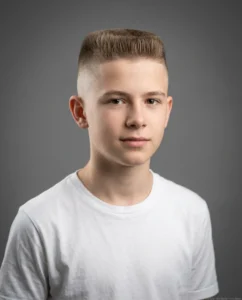
A faux hawk is one of the better cuts for thin hair after 40, mostly because it doesn’t ask thinning hair to do a job it can’t do anymore. The sides go short or fade to skin, so all the visual weight sits in one narrow strip on top — and a narrow strip of hair looks a lot denser than the same amount spread over a full head. Here are 23 versions worth showing your barber, from the barely-there classic to fades that pull double duty on a beard.
1. Classic Short Faux Hawk

This is the cut most guys picture first, and it works better than most people expect on hair that’s thinning at the crown. The sides are clippered down to a #2 or #3, the top is left around an inch, and everything gets combed up into a narrow ridge running front to back. Because the strip is only about two fingers wide, you don’t need much density to make it stand up — a dime-sized amount of matte clay does the job in under a minute.
Where it struggles is if your hair is thinning right at that center strip too, not just the sides. In that case the ridge can look see-through under bright light, which somewhat defeats the point. Ask your barber to leave slightly more length, closer to an inch and a quarter, if the crown itself is where you’re losing density.
2. Textured Crop Faux Hawk
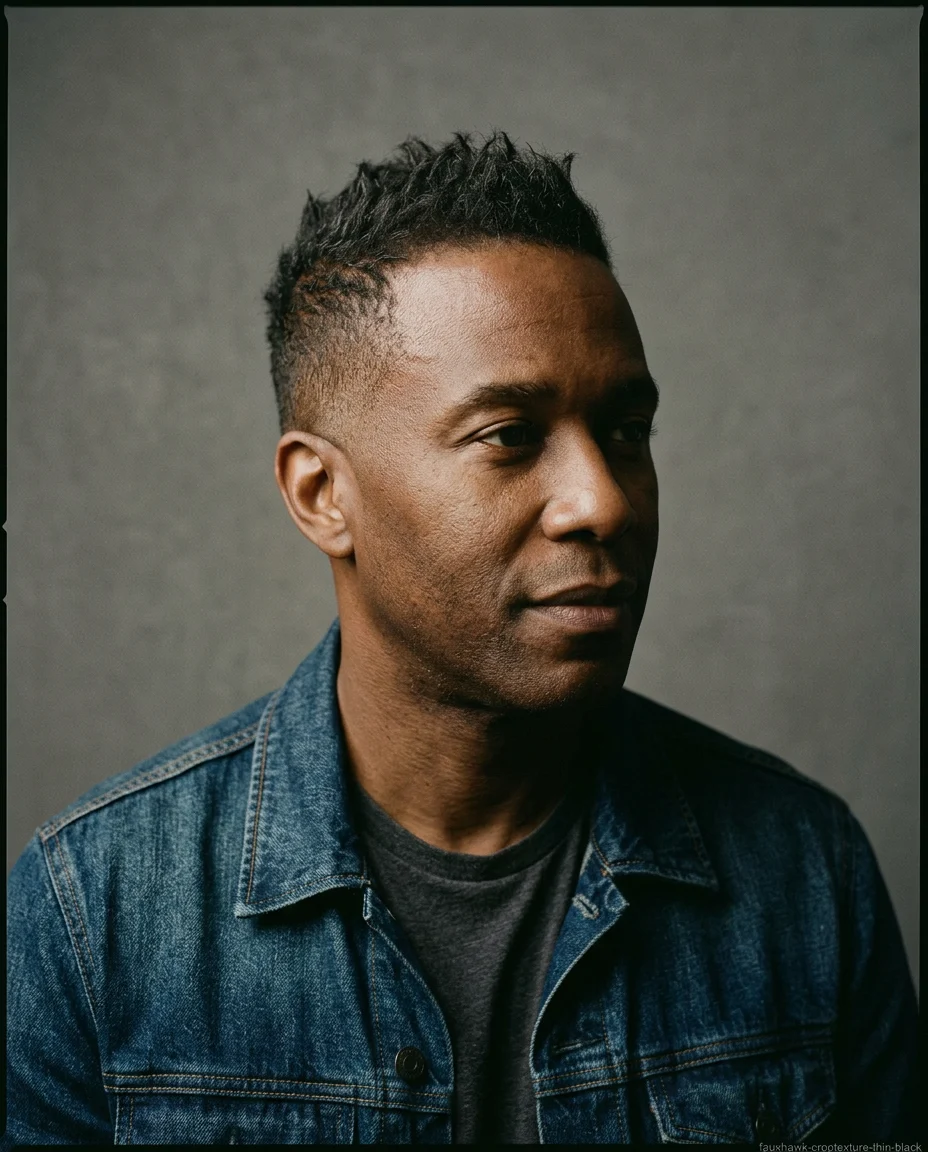
Texture does something a plain faux hawk can’t — it breaks up the light instead of reflecting it straight back at whoever’s looking at your scalp. A textured crop keeps the top short, somewhere around three-quarters of an inch, cut with a razor or point-cutting shears so the ends land at slightly different lengths. The sides taper down gradually rather than fading hard, which suits a face that’s started to show some age around the jaw.
The trade-off is styling time. A clean faux hawk takes maybe 90 seconds with a comb; this one takes closer to 4 or 5 minutes because you’re scrunching product through by hand instead of just combing it up. Worth it if you’ve got the morning for it. Not if you don’t.
3. Faux Hawk with Skin Fade
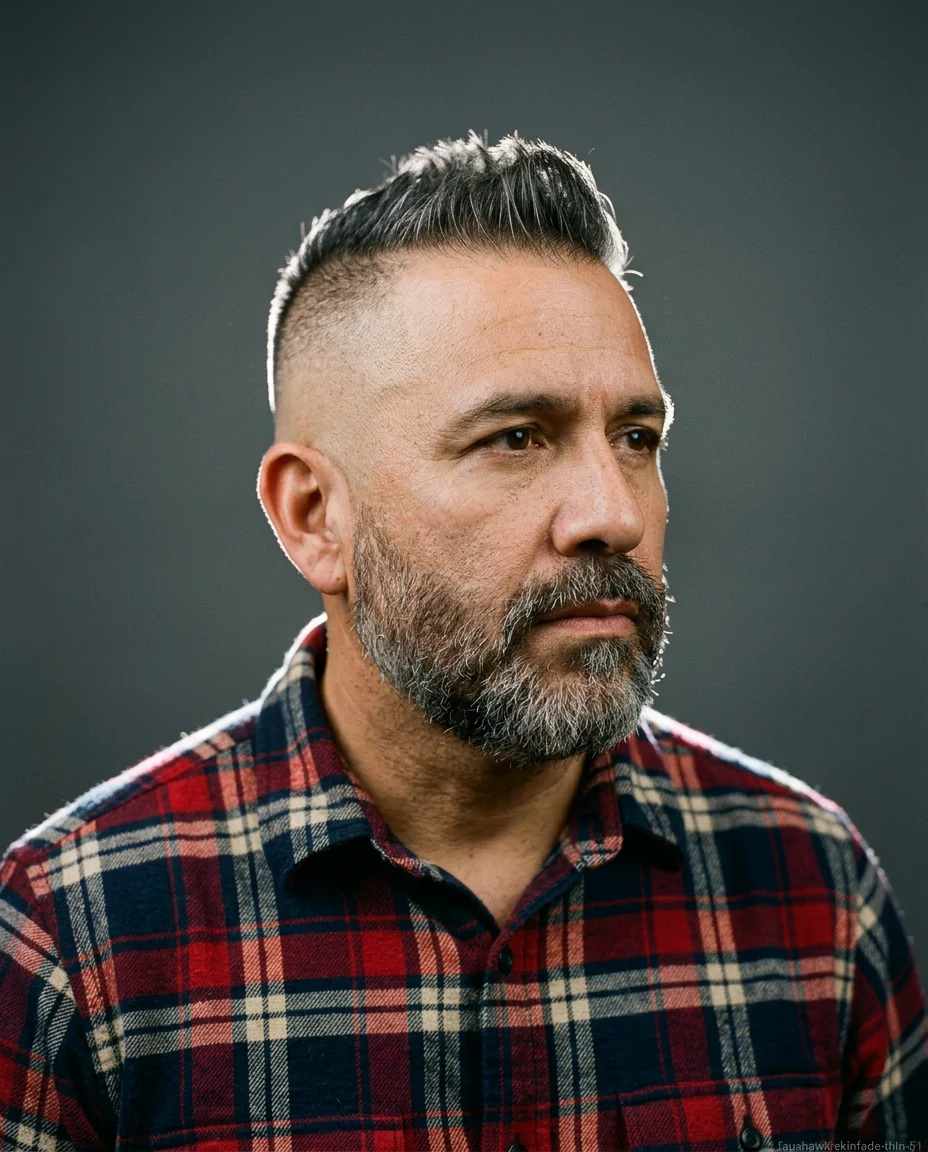
A skin fade removes the guesswork completely — there’s no length on the sides to compare against the top, so the eye has nothing to measure thinness by. The fade usually starts a half-inch above the ear and works down to bare skin over about an inch and a half of blending. On a guy in his 50s this reads as deliberate rather than trying too hard, which isn’t always true of tighter, younger fade styles.
It’s the highest-maintenance option on this list. Skin regrows visibly within 10 to 12 days, and once it does, the whole cut looks unfinished rather than just a little long. If you can’t commit to a barber visit every 2 weeks, this isn’t the one.
4. Faux Hawk with Taper Fade

A taper fade is the compromise between a skin fade and just leaving the sides longer — it fades but never goes all the way to skin, usually stopping around a #1 guard’s worth of length near the bottom. That softness matters more than people think once you’re past 40. A hard fade line next to a receding temple can actually draw more attention to it, not less.
This version is also more forgiving between barber visits. Because there’s no bare-skin line to grow out awkwardly, you can usually stretch to 5 weeks between cuts instead of 3.
5. Textured Faux Hawk with Undercut

An undercut drops the sides lower and more abruptly than a fade — think of it as a step down rather than a gradient. On thin hair this creates a sharp contrast that makes the top read denser by comparison, since there’s almost nothing left on the sides to compete with it. The top gets cropped into short, textured spikes, usually half an inch to an inch.
It’s a bolder look than most guys over 40 start with, and that’s fine — the honest answer is it depends on how conservative your workplace is. Client-facing finance jobs, probably skip it. Creative fields, it reads as confident rather than trying too hard.
6. Faux Hawk Fringe

If your hairline is receding more than your crown is thinning, a fringe pulled forward does more work than a strip standing straight up. The front section stays around an inch and a half and gets combed down and slightly to center, covering the corners where recession usually starts first. The sides taper close underneath.
Most guides skip this part, but a fringe only works if there’s enough density right at the hairline to comb forward in the first place. If that specific area is already thin, the fringe just makes it more obvious. A quick check with your barber before you commit saves you a bad first cut.
7. Side-Swept Faux Hawk

Instead of combing the top straight up, this version pushes it diagonally across the head, which covers more surface area per strand than a vertical style does. From the front three-quarter angle — which is how most people actually see you in conversation — it reads noticeably fuller than a straight-up faux hawk on the exact same amount of hair.
The sides stay short, usually a taper rather than a hard fade, so the whole look stays understated. It’s arguably the easiest version on this list to wear to work without anyone clocking that you’ve had a haircut at all.
8. Faux Hawk with Hard Part

A hard part is a shaved line, usually running from the front hairline back an inch or two above the temple. Next to that clean line, whatever hair sits above it looks denser than it actually is — the contrast does the work, not the volume. It’s a small detail, but it’s one barbers use specifically because it costs nothing extra and adds a sharpness a plain fade doesn’t.
It does need upkeep of its own, separate from the rest of the cut. The line grows out and blurs within about 8 to 10 days, faster than the fade around it does.
9. Grey Blend Faux Hawk

Gray hair and thin hair create a specific problem together — gray strands often feel coarser but grow in less densely, so a longer cut can look patchy rather than distinguished. Keeping everything short, with a tight fade blending directly into the gray at the sides, solves this by not giving any single patch enough length to stand out from its neighbors.
This is one case where going shorter than you’re used to actually helps rather than just being a style choice. Guys who keep their gray at an inch or more tend to notice the patchiness first. Guys who cut it to a half-inch mostly don’t.
10. Faux Hawk with Low Fade

A low fade keeps more length on the sides than a mid or high fade, starting its blend right around the ear rather than higher up the head. For thinning hair, more side length isn’t always better, but at 40-plus it often reads as more age-appropriate than a fade that climbs high up the skull.
It’s also the most forgiving fade to grow out. Because the starting point is already low, an extra week or two of neglect doesn’t create the obvious two-tone look that a high fade does.
11. Spiky Faux Hawk
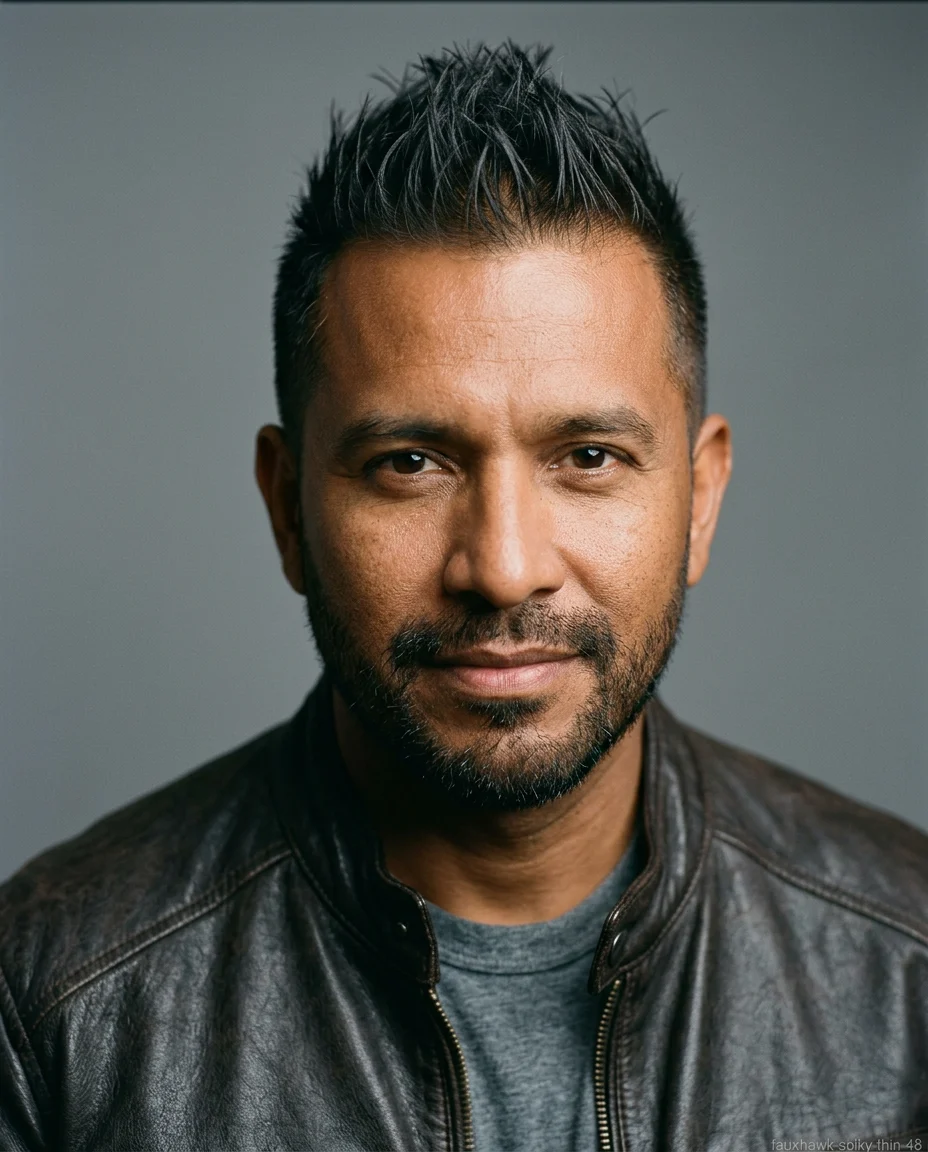
Short, worked-up spikes add texture without asking for length, which matters if your hair won’t hold a taller shape anymore anyway. A matte clay or fiber paste, worked through with fingertips rather than a comb, creates separated pieces about half an inch tall across the top.
This isn’t a wash-and-go style. Expect 3 to 4 minutes at the sink most mornings, and the payoff is texture that reads as thicker than a smoothed-down style using the identical amount of hair.
12. Faux Hawk Buzz Fade
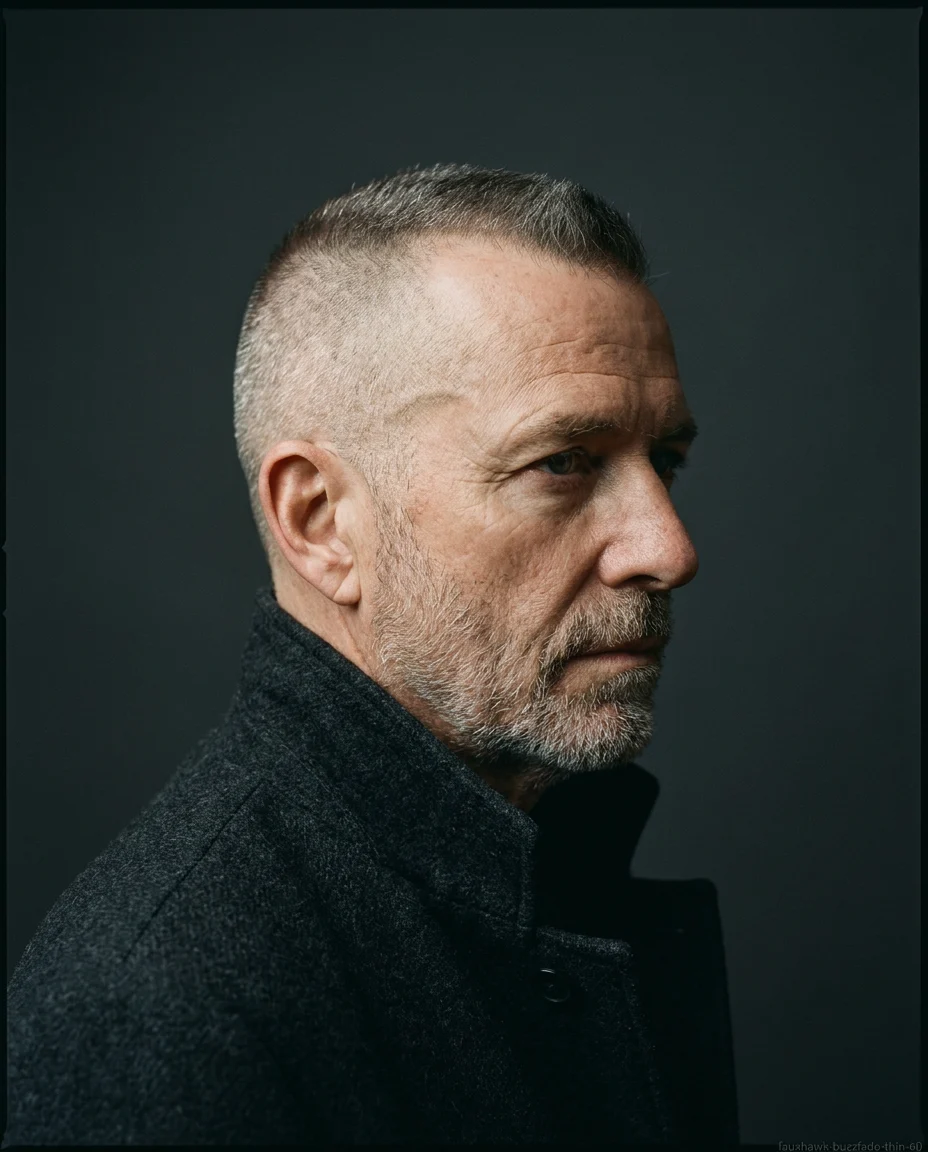
This is the low-maintenance end of the list. The top gets buzzed to a half-inch with a guard, leaving only a slightly longer center strip, maybe three-quarters of an inch, running front to back. The whole thing takes a barber about 12 minutes.
There’s no styling required afterward — no product, no comb, nothing. That’s the trade you’re making: less daily effort in exchange for a cut that looks intentional but not particularly dressed-up.
13. Textured Faux Hawk Quiff

A quiff lifts the front section up and slightly back rather than straight up, landing somewhere between a faux hawk and a pompadour. On thin hair it works because the lift happens mostly at the root, using a round brush and blow dryer, rather than relying on length that isn’t there.
It’s softer around the face than a sharp-standing faux hawk, which tends to suit a face that’s picked up some lines. The blow-drying step takes a few extra minutes compared to a simple comb-up, but it’s genuinely what makes this version look different from the rest.
14. Faux Hawk with Temple Fade

Fading right at the temple, rather than starting the blend further back, shortens the visual gap between a receding corner and the ear. It’s a small adjustment a barber can make on request, and it specifically targets the area where hairlines usually recede first on men over 40.
The rest of the cut can stay fairly standard — short sides, a modest strip on top. The temple detail is doing most of the corrective work here on its own.
15. Messy Faux Hawk
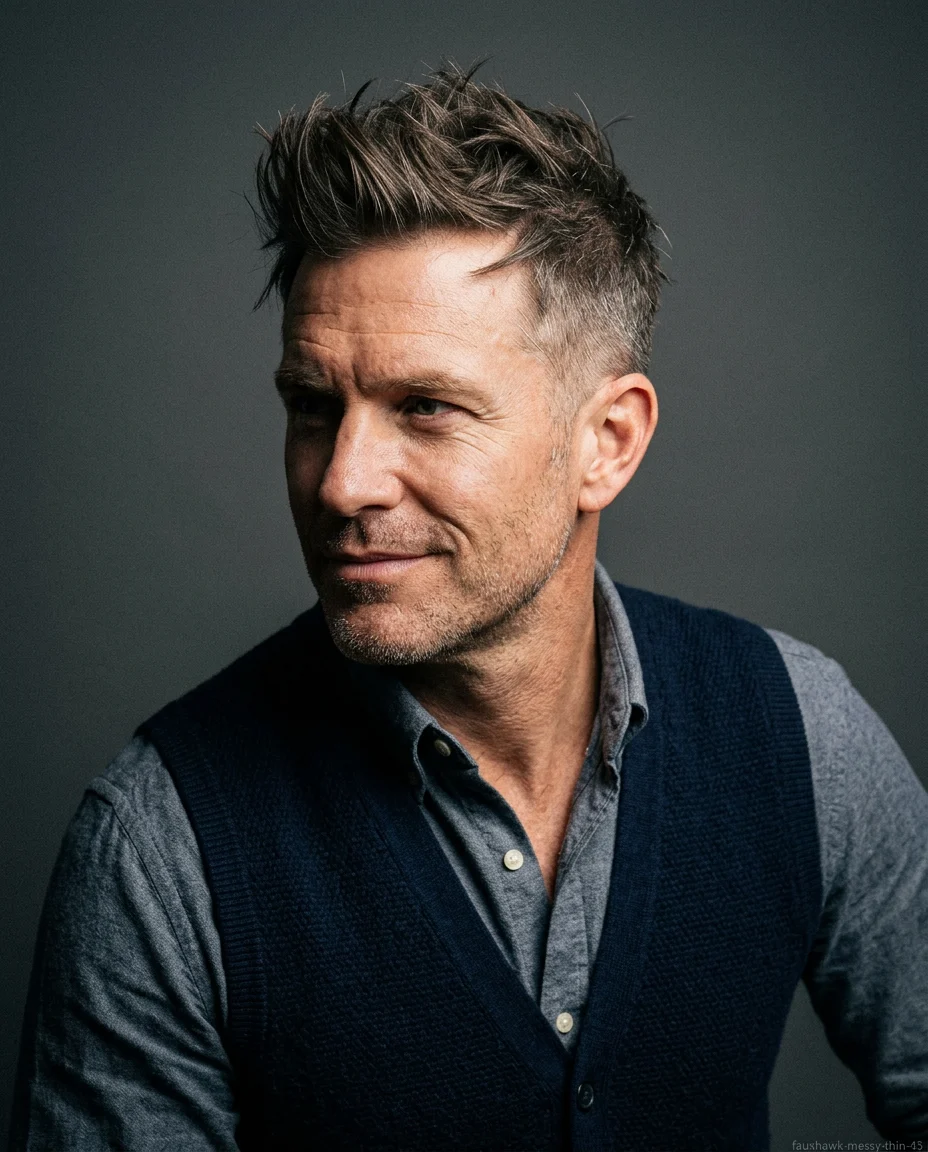
Skipping the comb and working product through with your hands leaves the top looking deliberately undone rather than sculpted. It’s a lower-effort look day to day, and it tends to hide thinning better than a slicked style does — uneven, piece-y texture doesn’t reveal a scalp the way flat, combed hair can.
Use a sea salt spray on damp hair before the clay goes in; it roughs up the texture enough that the clay has something to grip. Skipping that step usually means the style falls flat by early afternoon.
16. Faux Hawk Comb-Over Fade

A comb-over paired with a fade is one of the few styles on this list built specifically around covering a widening part rather than just distracting from thinness generally. Length stays longer on one side, usually 2 to 3 inches, and gets combed directly over the part line while the other side fades short underneath.
It needs more length up top than most faux hawk versions, so if you’re not growing it out already, expect this one to take a few extra weeks to reach a workable length.
17. Faux Hawk with Line Up

A line-up traces a crisp edge along the hairline at the forehead and temples, usually done with a straight razor or edger rather than clippers. It sharpens the whole shape without adding or removing any actual hair, which makes it one of the cheapest upgrades to any faux hawk on this list.
It fades fast, though — closer to a week before the edge starts softening, faster than any other detail mentioned here. Guys who get regular line-ups typically see a barber every 10 to 14 days just for touch-ups.
18. Faux Hawk Pompadour Blend

This version borrows the pompadour’s forward lift and blends it into a shorter faux hawk base, pushing more volume toward the front hairline than a standard faux hawk does. It suits a guy who’s thinning more at the crown than the front — the extra lift up front draws attention away from the back.
Achieving the lift takes a blow dryer and a boar-bristle brush, worked in sections while the hair is about 80 percent dry. Air-drying alone won’t get the same height.
19. Faux Hawk with Beard Fade
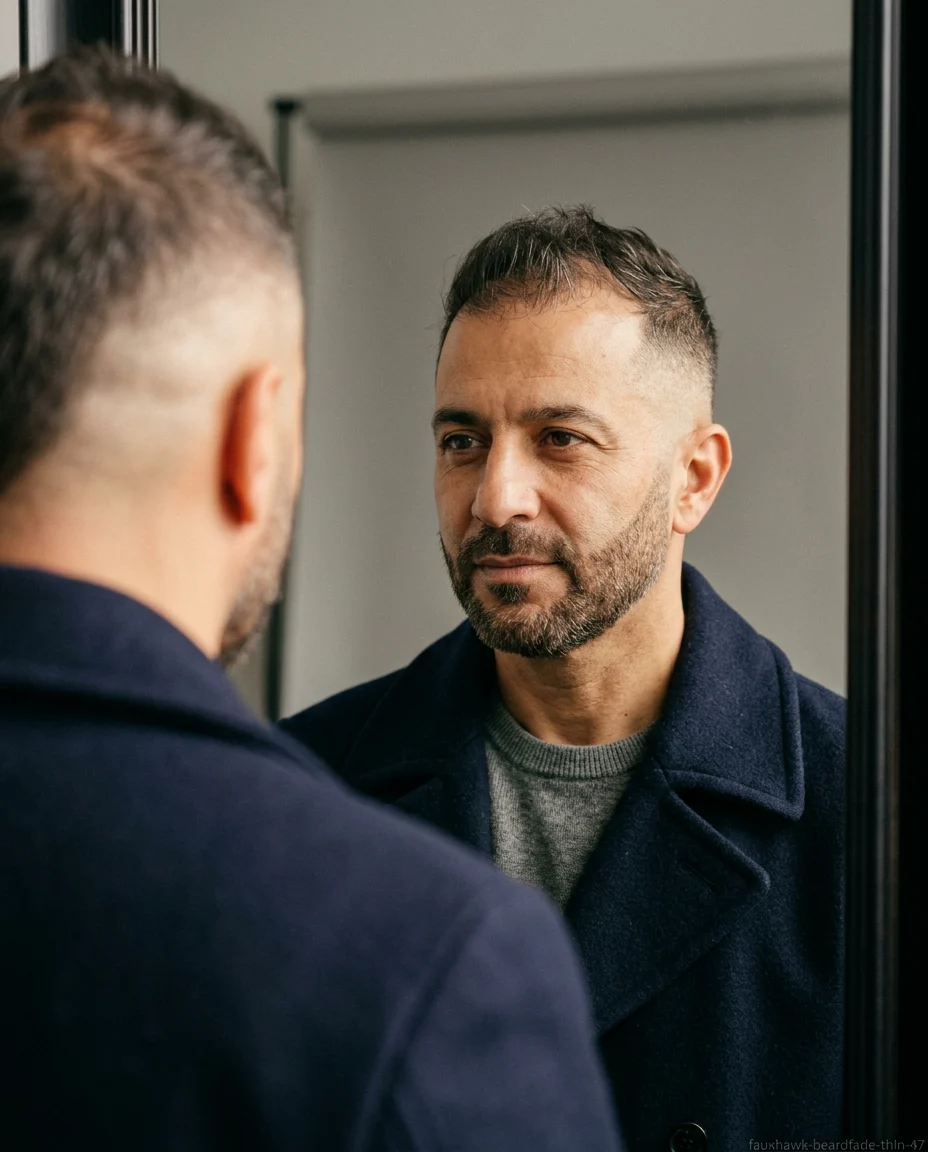
Extending the fade down into the beard line ties a thinning crown to a fuller jaw, which shifts where someone’s eye lands first when they look at you. Instead of the top, attention moves toward the beard and jawline, an area that usually doesn’t thin the same way scalp hair does after 40.
This needs a barber comfortable doing both hair and beard work in one visit, since the blend has to be continuous across the sideburn without an obvious seam.
20. Slick Faux Hawk

Combing the top straight back and flattening it with pomade, rather than spiking it up, is the lowest-effort version of this cut to maintain day to day. It still counts as a faux hawk because the sides are cut shorter than the top, just without the height most people associate with the style.
A water-based pomade works better here than a wax or clay — it combs through smoother and doesn’t leave the flaky residue heavier products can after a full day.
21. Faux Hawk Crop Fade

A French crop cut short and paired with a mid fade keeps the top uniform, usually around an inch, rather than building toward a peak or ridge. It’s arguably the most understated version on this list — from across a room it barely reads as a faux hawk at all, just a clean, short cut.
That subtlety is the appeal for guys who want the structural benefits — shorter sides, more visual density on top — without the styling commitment a taller shape requires.
22. Faux Hawk with Curtain Fringe
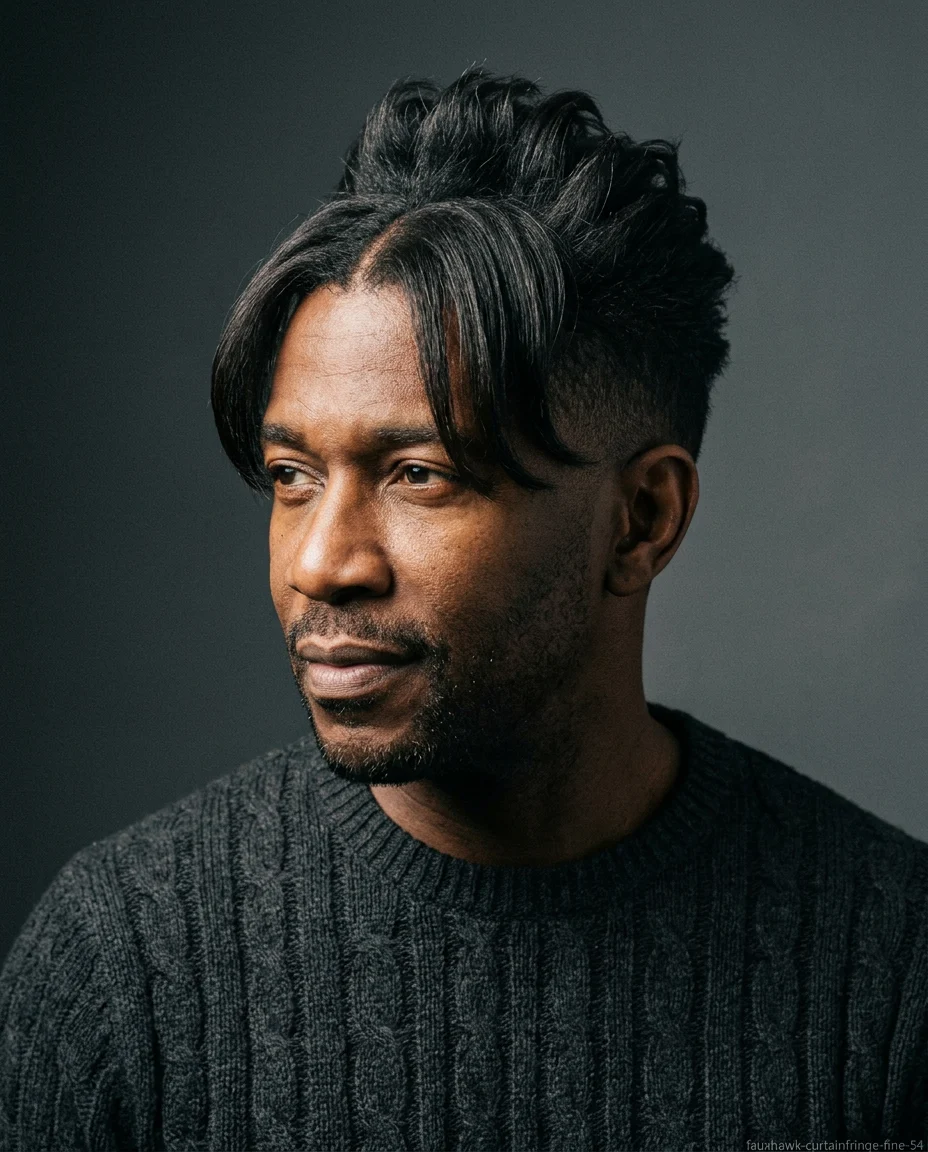
Curtains part the front section at the center and let it fall toward each temple, rather than combing everything straight back or up. Paired with tapered sides, it’s a softer, less structured take on the faux hawk shape, and one that tends to look younger than its actual maintenance level suggests.
It works best with hair that has at least some natural wave — dead straight fine hair sometimes struggles to hold the parted shape without added product.
23. Salt-and-Pepper Faux Hawk

Natural gray-and-dark mixed hair, kept short on top with a tight fade at the sides, tends to read as sharper rather than simply older. The mix of tones actually helps camouflage thinning in a way solid gray or solid dark hair doesn’t — the color variation itself breaks up the scalp’s visibility.
Keep the top around three-quarters of an inch. Longer than that and the salt-and-pepper mix starts looking more like uneven graying than an intentional two-tone effect.